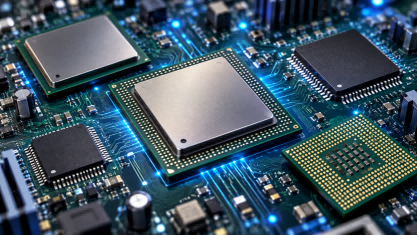
AMD (Xilinx), Altera, Lattice Semiconductor, and Microchip Technology are among the leading FPGA manufacturers, offering programmable logic solutions for applications ranging from embedded control to high-performance computing. Other specialized brands, including GOWIN, Efinix, and Achronix, provide alternatives for specific performance, power, and integration requirements.
This guide covers the top 10 FPGA manufacturers and brands in 2026, comparing their representative FPGA families, technical strengths, and primary applications. It also explains the key differences between manufacturers and how engineers and buyers can identify suitable FPGA vendors based on project requirements.
Top 10 FPGA Manufacturers and Brands in 2026
The global FPGA industry includes established semiconductor leaders and specialized programmable logic manufacturers serving different performance, power, and application requirements. AMD (Xilinx) and Altera offer extensive FPGA portfolios, while companies such as Lattice Semiconductor, Microchip Technology, and GOWIN focus on different combinations of embedded processing, power efficiency, and specialized applications.
The following list highlights 10 leading FPGA manufacturers and brands in 2026, selected based on their product portfolios, technological specialization, development ecosystems, and relevance to major FPGA applications. The order is an editorial selection rather than a strict ranking by global market share.
| Rank | FPGA Manufacturer / Brand | Country | Main Specialization |
|---|---|---|---|
| 1 | AMD (Xilinx) | USA | High-performance FPGA and adaptive computing |
| 2 | Altera | USA | High-performance and general-purpose FPGA |
| 3 | Lattice Semiconductor | USA | Low-power and embedded FPGA |
| 4 | Microchip Technology | USA | Non-volatile and high-reliability FPGA |
| 5 | GOWIN Semiconductor | China | Low-to-mid-density FPGA |
| 6 | Efinix | USA | Embedded FPGA and edge computing |
| 7 | Achronix Semiconductor | USA | High-bandwidth FPGA and eFPGA IP |
| 8 | QuickLogic | USA | Ultra-low-power programmable logic |
| 9 | NanoXplore | France | Radiation-tolerant FPGA |
| 10 | Cologne Chip | Germany | FPGA devices and open-source toolchains |
Each manufacturer offers distinct FPGA architectures, product families, and development resources. Understanding these differences helps engineers and buyers identify suitable vendors before comparing individual FPGA devices.
1. AMD (Xilinx)
| Category | Information |
|---|---|
| Manufacturer Type | FPGA and adaptive computing semiconductor manufacturer |
| Company Overview | Xilinx was founded in 1984 and acquired by AMD in 2022. AMD is a major semiconductor company offering programmable logic, adaptive SoCs, and computing platforms for embedded and high-performance applications. |
| Headquarters | Santa Clara, California, USA |
| Representative FPGA Families | Spartan, Artix, Kintex, Virtex, Versal |
| Technology Specialization | High-performance programmable logic, adaptive SoCs, embedded processing, high-speed connectivity, and heterogeneous computing. |
| Main Applications | Telecommunications, data centers, industrial automation, embedded vision, aerospace, and hardware acceleration. |
| Official Website | https://www.amd.com/ |
AMD is one of the leading semiconductor companies in the USA, with an FPGA portfolio spanning compact embedded devices to high-performance adaptive computing platforms. Spartan and Artix address cost- and power-conscious designs, while Kintex and Virtex provide greater logic capacity, DSP resources, and high-speed connectivity for demanding applications.
The Versal Adaptive SoC family extends programmable logic with integrated processing systems, network-on-chip interconnects, and specialized acceleration resources in selected devices. AMD also provides the Vivado and Vitis development ecosystems, supporting complex hardware implementations and application-specific acceleration. This broad combination of devices and software makes AMD relevant to projects ranging from industrial control to advanced communications and heterogeneous computing.
2. Altera
| Category | Information |
|---|---|
| Manufacturer Type | FPGA and programmable logic semiconductor manufacturer |
| Company Overview | Founded in 1983, Altera became part of Intel in 2015 and returned to independent operation in 2025. Following a majority-stake investment, Silver Lake holds 51% of Altera, while Intel retains 49%. |
| Headquarters | San Jose, California, USA |
| Representative FPGA Families | Agilex, Stratix, Arria, Cyclone, MAX 10 |
| Technology Specialization | High-performance FPGA architectures, high-speed interfaces, DSP processing, embedded integration, and programmable computing. |
| Main Applications | Telecommunications, data centers, industrial automation, networking, video processing, and embedded systems. |
| Official Website | https://www.altera.com/ |
Altera provides FPGA solutions across several performance and cost categories. Agilex targets demanding processing and connectivity requirements, while Stratix and Arria families serve high-performance and mid-range applications. Cyclone addresses more cost-conscious embedded designs, and MAX 10 integrates non-volatile configuration with additional system functions, including ADC capabilities in supported devices.
The company’s Quartus Prime software provides synthesis, placement, routing, timing analysis, and programming tools. Different software editions support different FPGA families, making compatibility an important consideration. Altera’s combination of established development tools, IP resources, and diverse programmable devices supports both high-speed systems and general-purpose embedded applications.
3. Lattice Semiconductor
| Category | Information |
|---|---|
| Manufacturer Type | Low-power FPGA and programmable logic semiconductor manufacturer |
| Company Overview | Founded in 1983, Lattice Semiconductor specializes in programmable logic solutions for power-sensitive, embedded, and connectivity applications, with an expanding portfolio extending into mid-range FPGA devices. |
| Headquarters | Hillsboro, Oregon, USA |
| Representative FPGA Families | iCE40, MachXO, CrossLink, Certus, Avant |
| Technology Specialization | Low-power FPGA architectures, compact integration, system management, interface bridging, embedded vision, and programmable connectivity. |
| Main Applications | Industrial automation, consumer electronics, embedded systems, video interfaces, networking equipment, and edge computing. |
| Official Website | https://www.latticesemi.com/ |
Lattice is particularly recognized for FPGA solutions where low power consumption, compact packages, and efficient system integration matter more than maximum logic capacity. The iCE40 family supports small embedded and portable designs, while MachXO devices are commonly used for board management, control sequencing, and interface bridging. CrossLink addresses camera and video connectivity requirements.
Lattice also offers Certus devices for general-purpose FPGA applications and Avant platforms for designs requiring greater programmable resources. Its development ecosystem includes Radiant and Diamond software, with tool support depending on the selected family. This product diversity makes Lattice relevant to embedded control, industrial interfaces, and increasingly demanding edge processing applications.
4. Microchip Technology
| Category | Information |
|---|---|
| Manufacturer Type | FPGA, FPGA SoC, and high-reliability semiconductor manufacturer |
| Company Overview | Founded in 1987, Microchip Technology expanded its FPGA business through the acquisition of Microsemi in 2018. Its programmable logic portfolio serves commercial, industrial, embedded, aerospace, and specialized high-reliability markets. |
| Headquarters | Chandler, Arizona, USA |
| Representative FPGA Families | PolarFire, PolarFire SoC, SmartFusion2, IGLOO2, RTG4, RT PolarFire |
| Technology Specialization | Non-volatile FPGA configuration, power-efficient architectures, embedded processors, security features, and specialized radiation-tolerant devices. |
| Main Applications | Industrial automation, communications, embedded systems, aerospace, space electronics, and high-reliability equipment. |
| Official Website | https://www.microchip.com/ |
Microchip distinguishes itself through FPGA families that combine non-volatile configuration, power-efficient operation, and specialized reliability features. PolarFire devices serve mid-range logic and embedded processing requirements, while PolarFire SoC integrates a multi-core RISC-V processor subsystem with FPGA fabric. SmartFusion2 combines flash-based programmable logic with an Arm Cortex-M3 processor.
For aerospace applications, RTG4 and RT PolarFire provide dedicated radiation-tolerant solutions. These characteristics apply to specific device families and qualification levels rather than every Microchip FPGA. The company’s Libero SoC development environment supports implementation, timing analysis, and IP integration, making Microchip particularly relevant to embedded systems requiring long-term hardware reliability.
5. GOWIN Semiconductor
| Category | Information |
|---|---|
| Manufacturer Type | FPGA and programmable logic semiconductor manufacturer |
| Company Overview | Established in 2014, GOWIN Semiconductor is a Chinese FPGA company developing programmable logic devices and supporting design software for embedded, industrial, communications, and consumer electronics applications. |
| Headquarters | Guangzhou, Guangdong, China |
| Representative FPGA Families | LittleBee, Arora, GW1N, GW2A, GW3A |
| Technology Specialization | Small-to-medium FPGA devices, embedded memory integration, programmable interfaces, DSP resources, and cost-conscious digital logic solutions. |
| Main Applications | Industrial control, communication equipment, display electronics, interface conversion, and embedded systems. |
| Official Website | https://www.gowinsemi.com/ |
GOWIN focuses on providing programmable logic for applications that require moderate FPGA resources, flexible digital interfaces, and integrated embedded functions. Its LittleBee families address relatively compact designs, while Arora products extend the available logic capacity and processing resources for more demanding implementations.
Depending on the selected device, GOWIN FPGAs can incorporate embedded memory, DSP blocks, clock management, and specialized interface resources. The company’s GOWIN EDA software supports design implementation and device programming. Its products are relevant to engineers comparing smaller FPGA platforms for industrial interfaces, control systems, and digital signal processing, although exact performance and cost must be evaluated at the device level.
6. Efinix
| Category | Information |
|---|---|
| Manufacturer Type | FPGA and programmable logic semiconductor manufacturer |
| Company Overview | Efinix is a U.S.-based FPGA company developing programmable devices for embedded systems, industrial electronics, and edge computing. Its product strategy emphasizes architectural efficiency and scalable programmable logic. |
| Headquarters | Cupertino, California, USA |
| Representative FPGA Families | Trion, Titanium, Topaz |
| Technology Specialization | Quantum programmable fabric, embedded processing, power-efficient FPGA architectures, DSP capabilities, and edge-oriented computation. |
| Main Applications | Embedded vision, industrial automation, edge AI, image processing, and communication interfaces. |
| Official Website | https://www.efinixinc.com/ |
Efinix is known for its Quantum programmable fabric architecture, which employs configurable logic and routing resources to support FPGA implementation. The Trion family targets relatively compact embedded applications, while Titanium devices extend into higher logic density, increased processing resources, and more demanding connectivity requirements.
Efinix provides the Efinity development environment for FPGA design, synthesis, implementation, timing analysis, and programming. Its product portfolio is particularly relevant to embedded vision and edge processing systems where processing flexibility, power consumption, and hardware integration must be balanced. Actual performance advantages depend on the device selected and the implemented design.
7. Achronix Semiconductor
| Category | Information |
|---|---|
| Manufacturer Type | High-performance FPGA manufacturer and eFPGA IP provider |
| Company Overview | Founded in 2004, Achronix develops high-performance standalone FPGA devices and embedded FPGA intellectual property for data-intensive computing and custom semiconductor applications. |
| Headquarters | Santa Clara, California, USA |
| Representative FPGA Families | Speedster7t, Speedcore eFPGA IP |
| Technology Specialization | High-bandwidth processing, 2D network-on-chip architecture, high-speed connectivity, programmable acceleration, and embedded FPGA integration. |
| Main Applications | Data centers, AI acceleration, networking, telecommunications, and custom ASIC or SoC development. |
| Official Website | https://www.achronix.com/ |
Achronix concentrates on applications where memory bandwidth, data movement, and programmable hardware acceleration are critical. Its Speedster7t FPGA family uses a 7 nm FinFET process and integrates a two-dimensional network-on-chip, GDDR6 memory interfaces, and high-speed connectivity capabilities, including PCI Express Gen5 and 400G Ethernet support.
Its Speedcore technology serves a different purpose: integrating eFPGA fabric directly into custom ASICs or SoCs rather than providing a separate packaged FPGA. The company’s ACE development environment supports FPGA implementation and optimization. These technologies distinguish Achronix from manufacturers primarily focused on lower-density embedded programmable logic.
8. QuickLogic
| Category | Information |
|---|---|
| Manufacturer Type | Ultra-low-power programmable logic and eFPGA IP provider |
| Company Overview | Founded in 1988, QuickLogic develops programmable logic technology for power-sensitive embedded systems, sensor processing, and custom semiconductor integration. |
| Headquarters | San Jose, California, USA |
| Representative FPGA Families | EOS S3, ArcticPro, ArcticLink |
| Technology Specialization | Ultra-low-power programmable logic, embedded FPGA IP, sensor processing, and support for selected open-source FPGA development flows. |
| Main Applications | IoT devices, sensor processing, embedded electronics, portable systems, and custom SoCs. |
| Official Website | https://www.quicklogic.com/ |
QuickLogic focuses on programmable hardware for systems where power efficiency and integration are significant design constraints. Its EOS S3 platform combines an Arm Cortex-M4F processor with programmable logic and dedicated embedded functions, supporting applications such as sensor processing and low-power device operation.
The ArcticPro technology portfolio addresses embedded FPGA integration within custom silicon, while ArcticLink represents an earlier programmable connectivity family. QuickLogic also participates in open-source FPGA tool development. Engineers evaluating its products should distinguish standalone programmable devices from eFPGA IP, as these serve different hardware design and procurement requirements.
9. NanoXplore
| Category | Information |
|---|---|
| Manufacturer Type | Radiation-tolerant and radiation-hardened FPGA manufacturer |
| Company Overview | Founded in 2010, NanoXplore is a French semiconductor company developing FPGA solutions for space systems and other applications requiring specialized reliability characteristics. |
| Headquarters | Paris, France |
| Representative FPGA Families | NG-MEDIUM, NG-LARGE, NG-ULTRA |
| Technology Specialization | Radiation-hardening-by-design, high-reliability programmable logic, embedded processing, and FPGA solutions for space environments. |
| Main Applications | Satellites, space communications, onboard data processing, aerospace systems, and high-reliability electronics. |
| Official Website | https://nanoxplore.com/ |
NanoXplore specializes in FPGA architectures developed for demanding environments where radiation effects and system reliability must be considered throughout hardware design. Its NG-MEDIUM and NG-LARGE families provide programmable logic resources for different levels of processing complexity, while NG-ULTRA extends the portfolio with integrated processing capabilities.
The company’s radiation-hardened devices target spaceborne electronics requiring verified environmental characteristics. NanoXplore also offers commercial variants of selected technologies. Engineers must assess the exact device grade, radiation specifications, qualification requirements, and operating conditions rather than assuming all products share identical space-grade characteristics.
10. Cologne Chip
| Category | Information |
|---|---|
| Manufacturer Type | FPGA and programmable logic semiconductor manufacturer |
| Company Overview | Cologne Chip is a German semiconductor company developing digital integrated circuits and programmable logic devices. Its GateMate platform provides FPGA hardware supported by proprietary and open-source development workflows. |
| Headquarters | Cologne, Germany |
| Representative FPGA Families | GateMate, including CCGM1A1 devices |
| Technology Specialization | General-purpose programmable logic, configurable digital hardware, embedded interfaces, and open-source FPGA development support. |
| Main Applications | Embedded control, digital interface design, hardware prototyping, industrial electronics, and programmable logic development. |
| Official Website | https://www.colognechip.com/ |
Cologne Chip’s GateMate family provides configurable logic resources for general-purpose FPGA applications. The architecture supports embedded memory, programmable logic functions, clock management, and digital interface implementation, making it suitable for a range of embedded and digital system projects.
A distinctive feature is its support for open-source development tools, including Yosys for synthesis, nextpnr for placement and routing, and openFPGALoader for programming. This gives engineers an alternative development workflow, although IP availability, device capabilities, and tool compatibility still require project-specific evaluation. GateMate also represents an independent European FPGA option within the broader programmable logic market.
How Do You Compare and Choose the Right FPGA Manufacturer?
Selecting an FPGA manufacturer requires more than comparing company size or market position. FPGA vendors differ in logic capacity, power characteristics, configuration technologies, processor integration, high-speed interfaces, and development ecosystems. These differences determine which products are practical for a particular hardware design.
A manufacturer with extensive high-performance FPGA resources is not automatically the best option for a compact industrial controller. Similarly, a low-power FPGA family may be unsuitable for applications requiring large amounts of DSP processing, high-speed transceivers, or advanced memory interfaces.
Key Differences Between FPGA Manufacturers
The most useful comparison begins with the capabilities of each manufacturer’s product portfolio rather than treating every FPGA offered by a brand as equivalent.
| Manufacturer | Main Product Positioning | Development Ecosystem | Key Selection Consideration |
|---|---|---|---|
| AMD (Xilinx) | Broad portfolio and high-performance adaptive computing | Vivado, Vitis | Logic resources, SoC integration, IP support |
| Altera | General-purpose and high-performance FPGA | Quartus Prime | Connectivity, processing resources, software compatibility |
| Lattice | Low-power and embedded FPGA | Radiant, Diamond | Power consumption, interface support, device size |
| Microchip | Non-volatile and high-reliability FPGA | Libero SoC | Configuration technology, reliability, lifecycle |
| GOWIN | Low-to-mid-density FPGA | GOWIN EDA | Logic resources, cost, I/O availability |
| Efinix | Embedded and edge-oriented FPGA | Efinity | Processing resources, power, connectivity |
| Achronix | High-bandwidth FPGA and eFPGA IP | ACE | Data throughput, memory bandwidth, integration |
| QuickLogic | Ultra-low-power programmable logic and eFPGA | Product-dependent toolchains | Power efficiency, integration requirements |
| NanoXplore | Space and high-reliability FPGA | NanoXplore development tools | Radiation characteristics, qualification |
| Cologne Chip | General-purpose FPGA with open-source tools | Yosys, nextpnr | Toolchain support, IP availability |
Development tools and IP ecosystems can be as important as hardware specifications. An existing FPGA project may depend on vendor-specific IP cores, clocking resources, timing constraints, and implementation tools. Migrating to another manufacturer may therefore require additional engineering work even when the new device offers comparable logic capacity.
Reliability and power consumption also require device-level evaluation. FPGA architecture, operating temperature, voltage, configuration technology, and implemented logic all affect system performance. The manufacturer’s overall reputation cannot replace verification of the selected device’s specifications.
Choosing an FPGA Manufacturer by Application
The next step is matching the project’s requirements with manufacturers offering suitable FPGA families. Application requirements should guide the initial shortlist before detailed device-level comparisons.
| Application | FPGA Manufacturers to Consider | Primary Selection Factors |
|---|---|---|
| High-performance computing | AMD, Altera, Achronix | Logic capacity, DSP, memory bandwidth, high-speed interfaces |
| Edge AI and machine vision | AMD, Lattice, Efinix | Processing resources, latency, power, camera interfaces |
| Industrial control | Lattice, Microchip, GOWIN | I/O, reliability, power, lifecycle |
| Low-power embedded systems | Lattice, Microchip, QuickLogic | Power budget, integration, package size |
| Aerospace and space | Microchip, NanoXplore | Radiation tolerance, qualification, reliability |
| Cost-sensitive embedded designs | GOWIN, Efinix, selected mainstream families | Device cost, required logic, tools, availability |
Consider an industrial controller requiring moderate logic resources, several digital interfaces, and long-term production support. A compact FPGA may satisfy the technical requirements without the cost or complexity of a high-performance platform. Engineers should first verify logic capacity, I/O compatibility, power consumption, and software support before selecting a device.
For production projects, component availability and total development cost are equally important. These considerations include device pricing, software licensing, IP compatibility, product lifecycle, and potential migration expenses. Companies evaluating FPGA procurement can review FPGA suppliers and solutions to explore relevant device families and sourcing requirements.
When a project moves from initial selection to component procurement, CNCHIPDEPOT can also support electronic component sourcing and part-number inquiries. The final decision should remain based on verified specifications, application requirements, and available supply.
FPGA Market Demand and Growth Drivers
FPGA demand is supported by applications requiring parallel processing, low latency, and hardware that can be reconfigured as system requirements evolve. According to a September 2026 market assessment, the global FPGA market was estimated at USD 11.73 billion in 2025 and is projected to reach USD 19.34 billion by 2030, representing a forecast compound annual growth rate of 10.5%.
AI inference and edge computing are creating opportunities for application-specific acceleration, while data centers and 5G infrastructure require high-speed processing and adaptable communication hardware. Industrial automation increasingly uses real-time control and machine vision, and automotive ADAS systems create opportunities for programmable sensor and image processing.
These application demands help explain why FPGA manufacturers pursue different product strategies. Some emphasize high-performance computing and connectivity, while others focus on low-power embedded devices, industrial systems, or radiation-tolerant solutions. Long-term market forecasts indicate potential growth, although actual sales remain subject to inventory cycles and changing customer demand.
Conclusion
The leading FPGA manufacturers offer different strengths across high-performance computing, low-power embedded systems, networking, industrial control, and aerospace applications. AMD and Altera provide broad FPGA portfolios, while specialized manufacturers address particular architectural and application requirements.
Choosing the right FPGA manufacturer requires evaluating actual device capabilities, development tools, long-term availability, and project costs rather than relying on brand rankings alone.
FAQs
AMD (Xilinx) is generally recognized as a leading FPGA manufacturer. Altera is another major competitor. Exact rankings depend on market share, revenue, and the product categories included.
Neither is universally better. AMD (Xilinx) and Altera offer extensive FPGA portfolios, and the right choice depends on device performance, development tools, IP compatibility, cost, and application requirements.
Not entirely. Since September 2025, Altera has operated independently, with Silver Lake holding 51% and Intel retaining 49%.
Lattice, Microchip, and QuickLogic offer FPGA or programmable logic technologies targeting low-power applications. Actual power consumption depends on the device and implemented design.
AMD and Altera offer established development environments and educational resources. Lattice and other vendors also provide accessible development platforms. The best starting point depends on the development board, tools, and project requirements.