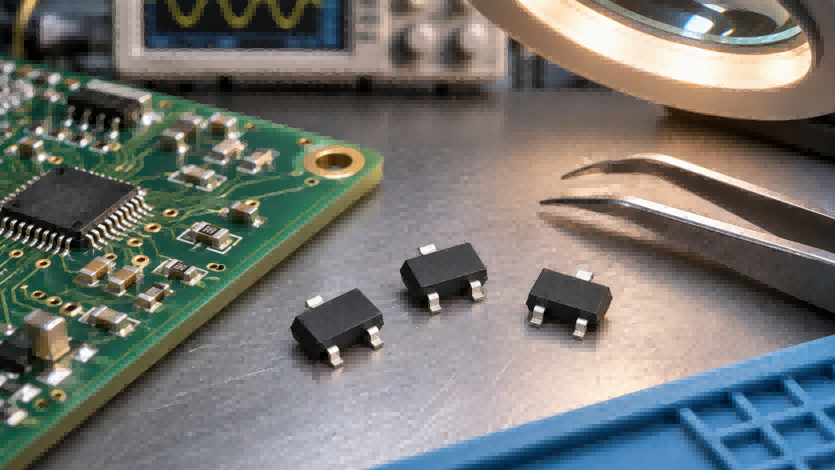
The BC847 transistor is a general-purpose NPN BJT commonly available in A, B, and C gain grades. BC847A, BC847B, and BC847C share the same basic 45 V, 100 mA SOT23 device family, while their main specified difference is the DC current gain, or hFE, range.
For engineers, sourcing teams, and BOM reviewers, the practical question is not simply which version has the highest gain. What matters is when the gain difference affects circuit behavior, which grade fits the application, and whether one BC847 grade can safely replace another.
BC847A vs BC847B vs BC847C: What Is the Difference?
The primary difference between BC847A, BC847B, and BC847C is their DC current gain classification. Same-family datasheet specifications show that the three grades share the same basic transistor type, package, collector-emitter voltage rating, and maximum continuous collector current.
| Parameter | BC847A | BC847B | BC847C |
|---|---|---|---|
| Transistor Type | NPN | NPN | NPN |
| Package | SOT23 | SOT23 | SOT23 |
| VCEO | 45 V | 45 V | 45 V |
| IC max | 100 mA | 100 mA | 100 mA |
| hFE | 110–220 | 200–450 | 420–800 |
| hFE Test Condition | VCE = 5 V, IC = 2 mA | Same | Same |
The suffix therefore does not indicate a different voltage class, current rating, or package. A, B, and C mainly identify different guaranteed gain ranges under defined test conditions. Typical gain values may also be listed in datasheets, but those should not be treated as fixed operating gains.
For selection and replacement, the guaranteed hFE range is generally more useful than a single typical value. A transistor can operate anywhere within its specified range, and its actual gain can also change with collector current, temperature, and normal device variation.
What Does the hFE Range Really Mean?
The hFE figures are easy to misread as three fixed amplification levels. In reality, BC847A, BC847B, and BC847C are gain classifications within the same transistor family. Two devices carrying the same suffix can therefore have noticeably different measured gain while both remaining within specification.
Understanding this distinction is important because it prevents two common mistakes: designing around one typical hFE value, and assuming that every transistor in a higher grade must have more actual gain than every transistor in the grade below it.
hFE Is a Range, Not a Fixed Value
BC847A is specified for an hFE range of 110–220, BC847B for 200–450, and BC847C for 420–800 at the stated VCE and collector-current test condition. These numbers define the allowable gain classification at that test point. They are not constant multiplication factors that apply throughout every operating condition.
Actual hFE changes with operating current, temperature, and device-to-device variation. A design that assumes every BC847B has one exact gain value can therefore behave differently when production parts fall closer to the lower or upper end of the specified range.
For practical circuit design, use the hFE range to understand the guaranteed classification, then evaluate the circuit using its real operating conditions and design margin rather than relying on one nominal gain figure.
Why the Gain Ranges Overlap
The three gain bins are not separated by hard gaps. BC847A and BC847B overlap from 200 to 220, while BC847B and BC847C overlap from 420 to 450.
This means an individual BC847A near the upper end of its range can have more measured gain than an individual BC847B near the bottom of its range. The same relationship can occur between B and C within their overlap region.
The suffix still indicates the guaranteed gain classification, but it does not specify the exact hFE of the individual transistor installed in a circuit. This becomes important during substitution because the design should be checked against guaranteed limits rather than an assumed fixed hierarchy between individual parts.
When Does the Gain Difference Matter?
Whether the difference between BC847A, BC847B, and BC847C matters depends primarily on how the transistor is being used. A saturated switching circuit and a gain-sensitive analog stage can react very differently to the same change in hFE grade.
This is more useful than assigning rigid labels such as “A for switching” and “C for amplification.” All three grades can be used in general-purpose switching and amplification. The important question is how strongly the circuit depends on transistor gain to establish current or bias.
Switching Circuits
When a BC847 is used to switch an LED, logic-controlled load, small relay, or another low-current device, a robust design normally provides enough base current to drive the transistor reliably into saturation. In this case, base-drive margin and required collector current are usually more important than simply selecting the highest hFE grade.
Saturation voltage is specified under defined collector-current and base-current conditions because switching behavior should not be evaluated by multiplying base current by a typical active-region hFE value. The designer instead checks whether the available base drive is sufficient for the load and whether VCE(sat), power dissipation, and thermal conditions remain within acceptable limits.
A switching circuit with comfortable base-drive margin may therefore tolerate more than one BC847 gain grade without a meaningful functional change. This does not make the three grades universally interchangeable; it simply means their hFE difference may have less influence in a well-driven saturated switch.
Amplification and Bias-Sensitive Circuits
In an amplification or bias-sensitive circuit, hFE can have a more direct effect. If collector current or the quiescent operating point depends substantially on transistor beta, moving between A, B, and C grades can change circuit behavior even though the package and maximum voltage and current ratings remain the same.
The difference may appear as a change in collector current, bias point, input impedance, or available signal swing. Circuits with strong negative feedback or emitter degeneration are generally more tolerant of transistor-gain variation than simple bias networks that depend more directly on beta.
For these applications, the more strongly the circuit relies on transistor gain to establish current or bias, the more important it becomes to match the intended hFE grade. The correct choice is therefore determined by the circuit requirement rather than by the highest available gain number.
Which BC847 Grade Should You Choose?
Choosing between BC847A, BC847B, and BC847C should begin with the circuit requirement. If the circuit already has adequate base-drive margin and does not depend strongly on transistor gain, more than one grade may satisfy the design. If available base current is limited or the operating point is sensitive to beta, the selected hFE range becomes more important.
BC847B is often a practical middle grade for general-purpose designs because its specified gain range sits between A and C. BC847C may be useful when a higher guaranteed minimum gain is required, while BC847A can be sufficient where the circuit does not need high minimum hFE.
| Design Situation | Selection Direction | Main Reason |
|---|---|---|
| Ample base-drive margin | A, B, or C may be workable | Minimum hFE may not control circuit behavior |
| General-purpose design | BC847B is often a balanced choice | Middle gain classification |
| Limited available base current | Consider a higher-gain grade | Provides more gain margin |
| Bias-sensitive analog circuit | Match the intended grade | hFE variation may shift the operating point |
| Existing production BOM | Keep the original grade unless verified | Avoid an unvalidated electrical change |
The key point is that BC847C is not simply an upgraded BC847B, and BC847B is not automatically a better BC847A. Higher gain is only useful when the circuit benefits from it. For an existing design that has already been validated with one grade, retaining that grade is normally the lowest-risk option unless there is a clear reason to change it.
Can BC847A, BC847B and BC847C Replace Each Other?
BC847A, BC847B, and BC847C are commonly package- and pin-compatible within the same BC847 family, but that does not automatically make them electrically interchangeable in every circuit. Physical compatibility is only the first step; the different guaranteed hFE ranges must also be considered.
The direction of substitution matters. Moving from a higher-gain grade to a lower-gain grade deserves more attention because the original circuit may rely on the higher minimum hFE. Moving in the opposite direction can be easier to validate in gain-tolerant circuits, but a higher-gain part still should not be treated as a universal upgrade.
| Replacement | General Assessment | Main Risk to Check |
|---|---|---|
| BC847A → BC847B | Often easier to validate | Possible bias or current change |
| BC847A → BC847C | Usually physically compatible; verify electrically | Higher gain may affect sensitive biasing |
| BC847B → BC847A | More caution required | Lower guaranteed minimum hFE |
| BC847B → BC847C | Often possible, but not automatic | Bias-sensitive circuit behavior |
| BC847C → BC847B | More caution required | Original circuit may rely on higher minimum gain |
| BC847C → BC847A | Highest gain-related risk | Much lower guaranteed minimum hFE |
Replacement is therefore not symmetrical. For example, changing from BC847C to BC847B removes part of the guaranteed gain margin available in the original grade. If the circuit requires that higher minimum gain, the lower-grade substitute may not behave the same under worst-case conditions.
A BC847B-to-BC847C substitution does not create the same minimum-gain limitation, but higher transistor gain can still shift the operating point of a sensitive analog stage. For a well-driven saturated switch, the grade difference may matter much less.
For production BOM changes, an electronic parts cross reference can help identify possible alternatives, but the final approval should still be based on package, pinout, electrical ratings, gain requirements, and actual circuit conditions.
Replacement Checklist
Before approving one BC847 grade as a substitute for another, the verification process should stay focused on the parameters that can actually affect the application. There is usually little value in comparing every datasheet field when many of them do not influence the circuit.
- Confirm package and pinout. Verify the exact ordering part number, SOT23 footprint, and Base–Emitter–Collector configuration.
- Check voltage and current ratings. Confirm that VCEO and collector-current requirements are satisfied.
- Compare minimum hFE. Pay particular attention when moving from C to B or from B to A.
- Review switching conditions. For saturated switching, check base current, load current, and VCE(sat) requirements.
- Check bias sensitivity. Determine whether a different gain grade can materially shift collector current or the operating point.
- Review thermal conditions. Power-dissipation limits depend on mounting and PCB conditions and should not be compared without their associated thermal assumptions.
The same approach applies when evaluating other BJT transistors for BOM substitution. Package compatibility alone does not prove electrical equivalence; the replacement must also fit the actual operating requirements and available design margin.
SMD Marking and Manufacturer-Specific Differences
SMD markings can help identify a BC847 grade on an assembled PCB, but the marking format is not universal. One product family may use a code based on “1F” for BC847B, while another may use an additional prefix or a different complete marking format.
Other specifications such as VCE(sat), transition frequency, power dissipation, and thermal conditions can also vary between production sources even when the BC847 grade is the same. For a clean A/B/C comparison, use one same-family datasheet whenever possible, and for production substitution always verify the exact part number being sourced.
Conclusion
BC847A, BC847B, and BC847C mainly differ in their DC current gain classifications. BC847A provides the lowest specified gain range, BC847B occupies the middle range, and BC847C provides the highest guaranteed minimum gain. That difference matters most in circuits that rely directly on transistor gain to establish current or bias.
Higher hFE does not automatically make one grade better. New designs should use the grade that provides sufficient gain margin for the intended operating conditions, while BOM substitutions should be verified electrically rather than approved from package and pinout alone. For second-source or transistor replacement projects, China Chip Depot can support component sourcing and parameter-matching requirements.
FAQs
What is the main difference between BC847B and BC847C?
The main difference is hFE. BC847B is specified for 200–450, while BC847C is specified for 420–800 under the same stated test condition. Their basic package, voltage rating, and collector-current capability can otherwise be the same within the family.
Can BC847B replace BC847C?
Sometimes. They may share the same package and pinout, but BC847C has a higher guaranteed minimum hFE. If the original circuit relies on that higher gain, BC847B should not be substituted without verification.
Is BC847C better than BC847B?
Not automatically. BC847C provides a higher gain range, but higher hFE is only useful when the circuit needs it. A well-driven switching circuit or a design already optimized around BC847B may gain no practical benefit from BC847C.
Are BC847A, BC847B and BC847C pin-compatible?
Within the same BC847 SOT23 family, the three gain grades normally use the same package and pin configuration. The exact datasheet should still be checked before approving a production substitution.
What is the difference between BC847 and BC547?
Both are general-purpose NPN transistor families used for switching and small-signal amplification. BC847 is commonly supplied in a surface-mount SOT23 package, while BC547 is commonly used in a through-hole package. They should not be treated as physical drop-in replacements without checking PCB layout, pinout, gain grade, and operating requirements.