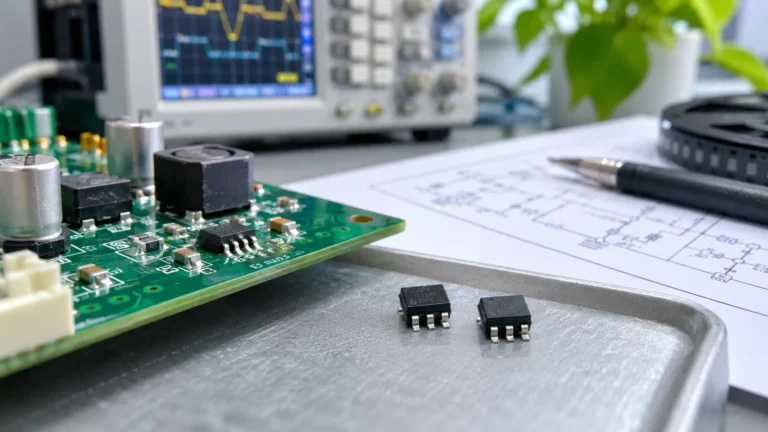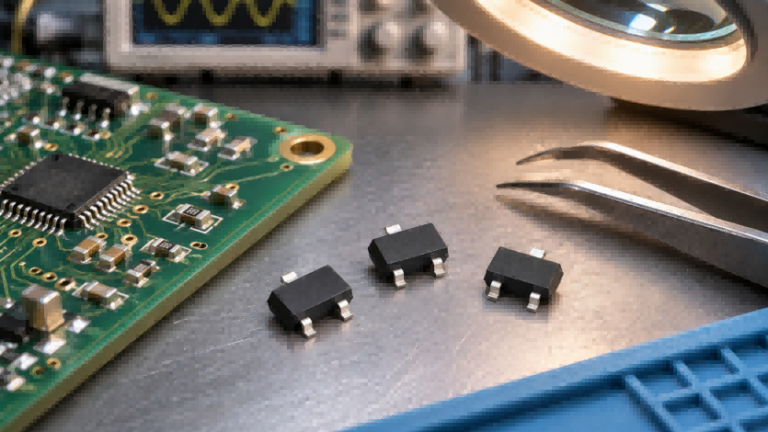

TLV431AIDBZR-TP and TLV431BIDBZR-TP are closely related adjustable shunt regulators, but they are not identical. Both use a nominal 1.24 V reference, the same DBZ / SOT-23-3 package, and the same industrial temperature grade. The main difference is initial reference accuracy at 25°C: TLV431A is specified at ±1%, while TLV431B tightens this to ±0.5%.
For most engineers and buyers, the real question is not simply which part is “better.” It is whether the tighter B-grade accuracy matters in the actual circuit, whether one device can replace the other, and whether the rest of the design is precise enough to benefit from that difference.
TLV431AIDBZR-TP vs TLV431BIDBZR-TP: Quick Comparison
The easiest way to compare these two parts is to separate the specifications that are effectively the same from the few that can influence a design or replacement decision.
| Specification | TLV431AIDBZR | TLV431BIDBZR | Practical Meaning |
|---|---|---|---|
| Nominal reference voltage | 1.24 V | 1.24 V | Same reference target |
| Initial VREF tolerance at 25°C | ±1% | ±0.5% | Main accuracy difference |
| VREF range at 25°C | 1.228–1.252 V | 1.234–1.246 V | B has a tighter initial spread |
| Minimum cathode current, max | 80 µA | 100 µA | Check very low-current designs |
| Adjustable output range | 1.24–6 V | 1.24–6 V | Same usable range |
| Operating temperature | −40°C to +85°C | −40°C to +85°C | Same I-grade range |
| Package | DBZ / SOT-23-3 | DBZ / SOT-23-3 | Same footprint |
| Pinout | Same | Same | Pin-compatible package |
The main selection difference is therefore reference-voltage accuracy, but the minimum cathode-current limit should not be ignored when evaluating a direct replacement. In most normally biased circuits this may not change the decision, but it becomes relevant when the device is operated close to its minimum regulation current.
One naming detail is also worth clarifying. Current official orderable numbers are typically listed as TLV431AIDBZR and TLV431BIDBZR. If “-TP” appears in a supplier listing, it should be verified within that supplier’s own ordering system rather than assumed to be part of the official part number.
What Does ±1% vs ±0.5% Mean in Practice?
The difference between ±1% and ±0.5% becomes much easier to understand when it is converted into an actual reference-voltage range. Both devices target the same 1.24 V value, but the B grade allows less initial variation around that target.
Reference Voltage Difference
For TLV431A, a ±1% tolerance corresponds to roughly ±12.4 mV. This gives an initial reference range of approximately 1.228 V to 1.252 V.
For TLV431B, the ±0.5% tolerance corresponds to roughly ±6.2 mV, narrowing the range to approximately 1.234 V to 1.246 V.
| Grade | Initial Tolerance | Approx. VREF Range |
|---|---|---|
| TLV431A | ±1% | 1.228–1.252 V |
| TLV431B | ±0.5% | 1.234–1.246 V |
In practical terms, the B grade roughly halves the allowed initial reference-voltage spread. That can matter in circuits where the reference itself represents a meaningful part of the total accuracy requirement.
How That Affects the Set Output
In a typical adjustable configuration, the output is set using an external resistor divider. A simplified relationship is:
VO ≈ VREF × (1 + R1/R2)
If the circuit is designed for a nominal 5 V output and other error sources are temporarily ignored, a ±1% reference contribution is about ±50 mV, while a ±0.5% contribution is about ±25 mV.
This does not mean a TLV431B-based 5 V circuit is automatically accurate to ±25 mV. The reference is only one part of the overall circuit. The resistor divider and operating conditions can contribute additional error, so the tighter B-grade reference is most useful when the rest of the design is also accurate enough to take advantage of it.
Temperature Stability and Other Accuracy Limits
A tighter initial tolerance does not mean TLV431B is automatically a better high-temperature or lower-drift device. Both TLV431AIDBZR and TLV431BIDBZR are I-grade parts with the same −40°C to +85°C operating range. The B designation primarily refers to tighter initial reference accuracy, not a different temperature class.
This distinction is important because system accuracy is not controlled by the reference alone. External resistor tolerance, resistor temperature behavior, reference current, cathode operating conditions, and temperature changes can all influence the final output.
For that reason, the useful question is not simply whether ±0.5% is better than ±1%. The better question is whether reference tolerance is one of the main limits in the actual design. If other components already introduce comparable or larger error, changing only the reference grade may provide less improvement than expected.
Can TLV431BIDBZR Replace TLV431AIDBZR?
TLV431AIDBZR and TLV431BIDBZR use the same DBZ / SOT-23-3 package and the same pin arrangement, so they are physically compatible at the package level. They also share the same nominal reference voltage, output range, and industrial temperature grade.
However, replacement should still be evaluated by direction. Moving from A to B is not exactly the same decision as moving from B to A.
Replacing A with B
Replacing TLV431AIDBZR with TLV431BIDBZR is generally the easier direction to evaluate. The B grade keeps the same nominal function while tightening the initial reference tolerance from ±1% to ±0.5%.
The main point to recheck is the minimum cathode-current requirement. The maximum specified minimum cathode current is 80 µA for TLV431AI and 100 µA for TLV431B. In a normally biased feedback circuit, this difference may not matter. In a very low-current design, however, the available current margin should be confirmed before treating the substitution as fully equivalent.
Replacing B with A
Replacing TLV431BIDBZR with TLV431AIDBZR requires more attention to accuracy. The package and pinout remain compatible, but the initial reference tolerance widens from ±0.5% to ±1%.
That may still be acceptable in a circuit with generous voltage or threshold margins. But if the original design depends on the tighter B-grade accuracy, moving to the A grade can reduce the available error margin.
Before approving either direction, check:
- Package and pin configuration
- Initial reference-voltage tolerance
- Minimum cathode-current requirement
- Operating-temperature range
- Required output or threshold accuracy
- BOM or customer qualification requirements
If you are evaluating other substitution options as part of a BOM review, an electronic parts cross reference can help narrow possible alternatives before the detailed electrical and package checks are completed.
Which One Should You Choose?
The better choice depends on whether the circuit actually benefits from tighter initial reference accuracy.
TLV431A is often sufficient for general regulation where the total allowable error is relatively wide. If the design is already qualified around a ±1% reference, or if other components contribute more error than the reference itself, moving to the B grade may provide limited practical benefit.
TLV431B becomes more useful when tighter reference accuracy directly improves the design margin. This can include circuits with narrower output tolerance, tighter threshold requirements, or precision resistor networks where reducing reference variation produces a measurable improvement.
| Design Requirement | More Suitable Choice |
|---|---|
| General-purpose regulation | TLV431A may be sufficient |
| Tighter initial reference accuracy | TLV431B |
| Existing design qualified for ±1% | TLV431A may remain appropriate |
| Lower unit-to-unit reference variation | TLV431B |
| Very low-current operation | Check minimum cathode current first |
| Replacing A with B | Usually easier to evaluate |
| Replacing B with A | Recheck the accuracy budget |
One practical rule is especially useful: if the external feedback divider already uses relatively loose-tolerance resistors, changing only the reference from ±1% to ±0.5% may not reduce the total system error by the same proportion.
For BOM review, sourcing support, or application-specific component selection, China Chip Depot can evaluate the part together with package compatibility, electrical limits, and production requirements rather than relying on the part number alone.
Most of the basic operating characteristics of the two parts are shared. Both are adjustable precision shunt regulators using a 1.24 V nominal reference, the same DBZ / SOT-23-3 package, the same pinout, and the same I-grade operating-temperature range.
These similarities are why the two parts are often considered closely related replacement candidates. For most users, there is little value in comparing every shared datasheet parameter line by line. The more useful checks are the specifications that can actually change the decision: initial reference tolerance and minimum cathode-current requirement.
Keeping the comparison focused on those differences makes it easier to determine whether the tighter B grade provides a real design advantage or whether the A grade already meets the required accuracy.
FAQs
What is the main difference between TLV431AIDBZR-TP and TLV431BIDBZR-TP?
The main difference is initial reference-voltage tolerance at 25°C. TLV431A is specified at ±1%, while TLV431B is ±0.5%. The B grade therefore provides a tighter initial reference-voltage spread.
Can TLV431BIDBZR replace TLV431AIDBZR?
Often yes, because the package, pinout, nominal reference, and temperature grade are the same. However, very low-current designs should recheck the minimum cathode-current requirement before approving the replacement.
Can TLV431AIDBZR replace TLV431BIDBZR?
It may be physically compatible, but the initial reference tolerance widens from ±0.5% to ±1%. Recheck the system accuracy or threshold margin before making the substitution.
Does TLV431B have better temperature stability than TLV431A?
Not by grade alone. Both I-grade versions use the same −40°C to +85°C operating range. The B grade mainly provides tighter initial accuracy at 25°C.
What is the difference between TLV431 and TL431?
They are related adjustable shunt-reference devices, but they are not the same part. TLV431 uses a lower reference voltage of about 1.24 V and is intended for lower-voltage designs, while TL431 uses a higher reference voltage and different operating limits.