When selecting or replacing NPN transistors, engineers often compare S8050 and SS8050 because these two part numbers appear very similar. However, similar names do not always mean identical performance or direct compatibility.
The difference between S8050 and SS8050 depends on factors such as package options, current capability, gain grades, and specific manufacturer specifications. In practical designs, the right choice is not always the transistor with higher ratings, but the one that best matches the circuit requirements.
This guide compares S8050 and SS8050 based on real component selection considerations, helping engineers understand their differences, evaluate replacement options, and choose the suitable transistor for different applications.
Why Are Engineers Comparing S8050 and SS8050 Transistors?
When selecting or replacing electronic components, engineers often encounter situations where two part numbers appear very similar but may represent different product versions. S8050 vs SS8050 is a common comparison because both names are widely used in the semiconductor market and are associated with general-purpose NPN transistor applications.
For engineers and purchasing teams, the purpose of comparing these two transistors is usually not simply to determine which one is “better.” Instead, the key question is whether one component can meet the requirements of an existing design, production process, or replacement project.
For example, a manufacturer may have an existing PCB design that uses an S8050 transistor in a SOT-23 package. Due to sourcing requirements, supplier availability, or production planning changes, the purchasing team may need to evaluate whether an SS8050 alternative can maintain electrical compatibility without requiring major design changes.
This type of component evaluation is common in electronic manufacturing. A transistor replacement that looks similar by name may still have differences in package options, manufacturer specifications, or product grades. These differences can affect PCB assembly, production consistency, and long-term supply reliability.
Another reason engineers compare S8050 and SS8050 is component sourcing flexibility. When working with widely used semiconductor parts, multiple manufacturers may provide similar models with different specifications or ordering options. Understanding the relationship between these two part numbers helps engineers make better decisions during new designs, PCB maintenance, and supply chain management.
Before comparing their specifications, it is important to understand what S8050 and SS8050 actually represent and why these transistors are commonly used in electronic circuits.
What Are S8050 and SS8050 Transistors?
S8050 and SS8050 are both NPN bipolar junction transistors (BJTs) commonly used as small signal transistors in electronic circuits. They belong to the 8050 transistor family and are widely applied in designs that require electronic switching, signal amplification, and low-power control functions.
A bipolar junction transistor (BJT) is a semiconductor device that uses a small input signal to control current flow through the transistor. As an NPN transistor, S8050 and SS8050 operate by controlling the current between the collector and emitter terminals through the base terminal. This basic function allows them to work as both signal amplifiers and electronic switches.
As small signal transistors, S8050 and SS8050 are mainly used in circuits where engineers need to process or control electrical signals rather than handle extremely high-power applications. Their general-purpose characteristics make them suitable for many electronic products, including consumer electronics, embedded systems, control boards, and other low-power circuit designs.
One of the common functions of these transistors is amplification. In signal processing applications, a transistor can strengthen a weak electrical signal so that it can be further processed by other parts of a circuit. For example, in an audio amplification circuit, an S8050 or SS8050-type transistor may be used to help amplify low-level signals before they reach the next stage of the system.
Another important function is switching. In switching applications, the transistor acts as an electronic control device that allows a low-power signal to control another component. For example, in an LED driver circuit, a transistor can be used to control the on/off state of an LED by responding to a small control signal. In sensor circuits, transistors can also help process output signals from sensors and control other electronic components.
The reason S8050 and SS8050 are widely used is their versatility. They provide a simple and practical solution for many general-purpose electronic designs where engineers need a compact semiconductor component for signal control and switching tasks.
Although S8050 and SS8050 share the same basic transistor type and are often used in similar applications, they should not be selected only based on their names. In practical engineering projects, factors such as package type and electrical characteristics play an important role in determining whether a specific version is suitable for a circuit design. The next section will compare the key differences between S8050 and SS8050, including package options, current capability, and other selection factors.
S8050 vs SS8050: Key Differences in Package, Current Capability and Gain
Although S8050 and SS8050 have very similar names and belong to the same NPN transistor family, they should not be considered identical components. In the semiconductor supply market, different manufacturers and product versions may provide different specifications, including package options, collector current capability, gain grades, and marking codes.
The comparison in this article is based on S8050 and SS8050 product versions available from CNCHIPDEPOT. Actual specifications may vary between manufacturers, suppliers, and production batches. Engineers should always refer to the specific datasheet provided for the selected component before making a final design or replacement decision.
For engineers and purchasing teams, the key question is not simply which transistor is “better,” but which version matches the requirements of a specific design. A suitable replacement or alternative needs to be evaluated based on the actual electrical characteristics and application conditions.
The main differences between S8050 and SS8050 are usually related to package selection, current capability, and available performance grades. These differences can affect PCB design, load-driving capability, and circuit reliability.
| Parameter | S8050 | SS8050 | Why It Matters |
|---|---|---|---|
| Transistor Type | NPN BJT | NPN BJT | Both belong to the same transistor family |
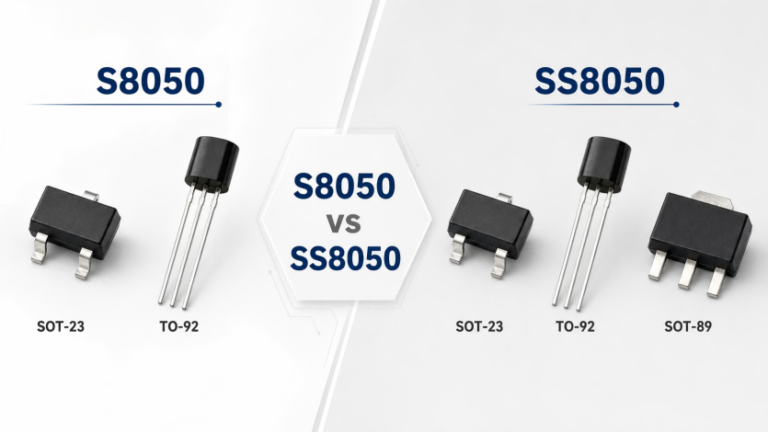
| Package Options | SOT-23, TO-92-3 | SOT-23, TO-92-3, SOT-89 | Affects PCB compatibility, assembly method, and thermal performance |
| Collector Current (Ic) | Some versions 500mA–800mA | Some versions up to 1.5A | Determines load-driving capability |
| Collector-Emitter Voltage (VCEO) | Depends on manufacturer | Depends on manufacturer | Determines voltage tolerance |
| DC Current Gain (hFE) | Different gain grades available | Different gain grades available | Affects amplification capability |
| Marking Code | Commonly J3Y in some SOT-23 versions | Commonly Y1 in some SOT-23 versions | Helps identify component marking |
Package Difference Between S8050 and SS8050
One of the practical differences between S8050 and SS8050 is the range of package options available from different suppliers.
S8050 is commonly available in packages such as SOT-23 and TO-92-3, which are widely used in general-purpose electronic designs. SOT-23 versions are popular in compact surface-mount applications, while TO-92 packages are often used in traditional through-hole circuit designs.
SS8050 is also available in common packages such as SOT-23 and TO-92-3. In addition, some SS8050 versions are available in SOT-89 packages, which provide different mechanical and thermal characteristics compared with smaller packages.
The availability of SOT-89 does not mean that SS8050 is always a higher-performance transistor. Instead, it provides engineers with another option when the circuit design requires different thermal or current-handling considerations.
Package selection can influence several practical aspects:
- PCB footprint and layout compatibility;
- surface-mount or through-hole assembly requirements;
- heat dissipation capability;
- mechanical integration.
For example, a compact consumer electronic product may prioritize a small SOT-23 package to save PCB space. In contrast, a design that operates with higher current or increased thermal stress may consider a package with better heat dissipation characteristics.
Therefore, when comparing S8050 and SS8050, package type should be treated as a design consideration rather than a simple indicator of which transistor is superior.
Current Capability Difference: Why Some SS8050 Versions Support Higher Loads
Another important difference between available S8050 and SS8050 versions is collector current capability.
The collector current (Ic) indicates the amount of current the transistor can control under specified operating conditions. This parameter becomes especially important when the transistor is used in circuits that drive external loads.
Some S8050 versions are commonly specified with collector current values around 500mA to 800mA, depending on the manufacturer and product grade.
In comparison, some SS8050 versions, particularly certain packages and product variants, are available with collector current ratings up to 1.5A.
This means that certain SS8050 versions may be more suitable for applications requiring higher load-driving capability, such as:
- medium-current switching circuits;
- LED driver applications;
- relay control circuits;
- electronic control boards with higher current requirements.
However, this does not mean that every SS8050 has lower current capability than every S8050. The actual specification depends on:
- manufacturer design;
- package type;
- product grade;
- operating conditions.
For this reason, engineers should compare the specific datasheet rather than selecting a transistor only based on the part number.
A transistor with a higher current rating may provide additional design margin, but if the circuit does not require that capability, other factors such as package size, availability, and overall compatibility may become more important.
Gain Difference: Is SS8050 Always Higher Gain Than S8050?
The difference in DC current gain (hFE) is one of the most discussed topics when comparing S8050 and SS8050.
Many engineers assume that SS8050 is a higher-performance version of S8050 because of the different naming. However, this is not necessarily correct.
The gain capability of a transistor depends on the specific product grade and test conditions, not simply on whether the part number contains “SS”.
Different S8050 versions may be available with gain grades such as:
- hFE 120–200;
- hFE 160–300;
- hFE 200–350.
SS8050 versions may also include similar gain grades, with some versions offering higher gain ranges depending on manufacturer specifications.
This means:
Gain depends on the specific transistor grade, not only the model name.
A higher hFE value can be useful in some amplification applications because it indicates stronger current amplification capability under certain conditions. However, a higher gain value does not automatically mean better overall performance.
The actual circuit requirements still matter. Engineers should consider:
- operating conditions;
- required signal characteristics;
- circuit stability;
- other electrical parameters.
For example, a transistor selected for signal amplification may place more emphasis on gain characteristics, while a transistor used for switching may focus more on current capability and thermal performance.
Replacement Evaluation Example
A common engineering situation is replacing an existing transistor during production or maintenance.
For example, a PCB design originally uses an S8050 in a SOT-23 package. Due to supplier availability or sourcing requirements, the purchasing team considers using an SS8050 alternative.
Before replacement, engineers should verify:
1. Package compatibility
Confirm that the replacement package matches the original PCB design.
2. Electrical characteristics
Check whether important specifications meet the circuit requirements, including:
- voltage rating;
- collector current;
- gain grade;
- power capability.
3. Actual circuit compatibility
Even when two components appear similar, the replacement should be evaluated within the actual circuit environment.
This example shows why S8050 and SS8050 should not be compared only by their names. A successful replacement requires matching the complete specifications of the original design.
Choosing Between S8050 and SS8050 for Different Applications
After comparing the package options, current capability, and gain grades of S8050 and SS8050, the next step is understanding how these differences affect real-world component selection. In practical circuit design, there is no universally better choice between S8050 and SS8050. The suitable transistor depends on the application requirements, PCB design limitations, and the operating conditions of the circuit.
Engineers usually select between these two transistor types based on what the circuit needs to achieve rather than simply choosing the model with higher specifications. A transistor optimized for signal processing may not be the best choice for switching applications, while a component with higher current capability may not be necessary for a low-power design.
The following table summarizes the main selection focus for different applications:
| Application | Main Selection Focus | Why It Matters |
|---|---|---|
| Small Signal Amplification | Gain grade and circuit condition | Ensures suitable signal amplification performance |
| LED Driver | Current capability and package | Helps maintain stable operation under load |
| Relay / Medium Load Switching | Collector current and thermal performance | Supports reliable switching operation |
| Compact PCB Design | SOT-23 compatibility | Reduces PCB redesign requirements |
| Higher Thermal Requirement | Consider SOT-89 options | Provides additional thermal management options |
Small Signal Amplification Applications
In small signal amplification circuits, such as audio circuits, sensor signal processing, and other low-level signal applications, the transistor is mainly used to strengthen or process electrical signals.
For these designs, engineers typically focus on whether the selected transistor provides suitable gain characteristics and stable operation under the required circuit conditions.
For example, an audio circuit may require a transistor that can provide consistent signal amplification without causing unexpected changes in circuit behavior. In this situation, the selection process is not simply about choosing the highest available gain version, but about finding a transistor grade that matches the circuit design.
Both S8050 and SS8050 can be considered for signal amplification applications, but the final selection should depend on the specific requirements of the circuit and the available product specifications.
LED Driver Applications
For LED driver circuits, the transistor is commonly used as an electronic control device to switch or regulate current supplied to the LED.
In these applications, engineers usually pay more attention to:
- whether the transistor can handle the required load;
- whether the package is suitable for the PCB design;
- whether the component can operate reliably under the expected conditions.
A compact SOT-23 version may be suitable for space-limited designs, while another package option may be considered when thermal performance becomes more important.
For LED applications, the goal is not necessarily to select the transistor with the highest gain, but to ensure reliable operation with the required load and circuit configuration.
Relay and Medium Load Switching Applications
When S8050 or SS8050 is used for relay control or other medium-load switching applications, engineers usually place more importance on load-handling capability and long-term reliability.
Compared with signal amplification applications, switching designs often require the transistor to repeatedly turn loads on and off while maintaining stable operation.
Important considerations include:
- whether the selected version provides sufficient current capability;
- whether the package can support the expected operating environment;
- whether thermal performance is suitable for continuous operation.
Some SS8050 versions with higher current capability may provide additional flexibility for applications requiring higher load handling. However, the actual suitability still depends on the specific product version and circuit requirements.
Compact PCB Design Applications
In modern electronic products, PCB space is often limited. For compact designs, package compatibility becomes an important factor during component selection.
Engineers working on small control boards, consumer electronics, or space-constrained devices may prioritize:
- SOT-23 package availability;
- PCB footprint compatibility;
- surface-mount assembly requirements.
In these situations, a transistor with a suitable package may be more practical than selecting a device with higher electrical ratings that requires PCB modification.
Therefore, package selection should be considered together with electrical requirements during the design process.
Higher Thermal Requirement Applications
Some circuit designs operate under higher thermal stress or require improved heat management. In these cases, engineers may consider package options that provide better thermal performance.
For example, certain SOT-89 package versions of SS8050 may provide additional flexibility where heat dissipation and current handling are important considerations.
However, package selection should always match the actual circuit requirements. A larger package does not automatically improve the overall circuit performance if the application does not require additional thermal capability.
Application Selection Summary
Choosing between S8050 and SS8050 depends on the role of the transistor in the circuit:
- For small signal amplification, engineers should focus on suitable gain grades and circuit conditions.
- For LED driver and switching applications, current capability, package type, and reliability become more important.
- For compact PCB designs, package compatibility may be the primary consideration.
- For higher thermal requirements, package options with better heat dissipation may provide additional advantages.
Ultimately, S8050 and SS8050 are both widely used NPN transistor options, and the correct choice depends on matching the component characteristics with the actual application requirements rather than selecting one model as universally superior.
Can SS8050 Replace S8050? A Practical Replacement Guide
When engineers need to replace an existing transistor, one of the first questions they ask is whether SS8050 can replace S8050 directly. Since these two part numbers are very similar and belong to the same NPN transistor family, it is easy to assume that they are interchangeable.
However, a similar part number does not always mean complete compatibility. SS8050 may be a suitable alternative to S8050 in some applications, but it should not be treated as a universal drop-in replacement. The actual compatibility depends on the specific product version, package type, electrical characteristics, and the requirements of the original circuit.
For example, a PCB design may originally use an S8050 transistor in a SOT-23 package. If an engineer considers replacing it with an SS8050, the replacement should be evaluated based on whether the new component can meet the original design requirements without changing the PCB or affecting circuit performance.
A practical replacement evaluation should include the following steps:
1. Verify Package and Pin Configuration
The first step is confirming whether the SS8050 version has the same physical characteristics as the original S8050.
Engineers should check:
- package type;
- pin arrangement;
- mounting compatibility.
For example, a SOT-23 S8050 replacement should be matched with an SS8050 version that uses the same package and compatible pin configuration.
Even when two components have similar names, different manufacturers may provide different package options or pin definitions. A mismatch at this stage can prevent the replacement from working correctly.
2. Confirm Electrical Compatibility
After confirming the physical match, engineers need to verify whether the electrical characteristics are suitable for the original circuit.
The key specifications to compare include:
- collector-emitter voltage capability;
- collector current capability;
- gain grade;
- power dissipation requirements.
The replacement component should meet the requirements of the original design rather than simply having similar naming.
For instance, a transistor used in a switching circuit may require sufficient current capability, while a transistor used in a signal-related circuit may require a suitable gain grade.
Since S8050 and SS8050 specifications can vary between manufacturers and product versions, engineers should always verify the specific datasheet of the selected component before making a replacement decision.
3. Consider Circuit Requirements, Not Only Component Specifications
Even when two transistors appear similar based on their basic specifications, the final decision should consider how the component works inside the actual circuit.
Different circuit designs may place different priorities on:
- switching performance;
- signal stability;
- load requirements;
- operating conditions.
A replacement that works well in one application may not provide the same result in another application.
For this reason, engineers should evaluate whether the replacement transistor maintains the expected circuit behavior rather than relying only on the similarity of the part numbers.
Common Replacement Mistake: Similar Names Do Not Mean Direct Compatibility
A common mistake occurs when engineers see:
S8050 / SS8050
and assume they can be exchanged immediately because the names are almost identical.
This may create problems such as:
- package or pin configuration mismatch;
- insufficient electrical capability;
- unexpected changes in circuit operation.
The correct approach is to treat SS8050 as a potential alternative rather than an automatic replacement. Engineers should verify compatibility step by step before applying the replacement in an existing design.
In summary, SS8050 can replace S8050 in certain applications, but the decision should be based on the specific component version and circuit requirements. A reliable replacement process requires checking package compatibility, electrical characteristics, and actual design conditions rather than relying only on similar part numbers.
How to Source S8050 and SS8050 for Production
When sourcing S8050 and SS8050 transistors for production, selecting the right component is not only about finding a part number that matches the design. Engineers and purchasing teams also need to confirm the specific package, electrical characteristics, and product version to ensure stable integration into the final application.
Because S8050 and SS8050 specifications can vary between manufacturers, working with a supplier that can provide multiple component options helps engineers find a suitable match for different production requirements.
At CNCHIPDEPOT, S8050 and SS8050 sourcing options can be evaluated based on different engineering requirements, including:
- Multiple manufacturer options for comparing specifications and selecting suitable versions;
- Different package choices to match PCB and assembly requirements;
- Different gain grades to meet various circuit design conditions;
- Common package formats such as SOT-23, TO-92, and SOT-89 for different application needs.
For production projects, engineers should confirm key information before placing orders, including:
- exact part number and manufacturer;
- package type and pin configuration;
- electrical specifications;
- application requirements.
This verification process helps reduce risks caused by selecting similar-looking components with different characteristics.
Whether the requirement is for a compact SOT-23 design, a traditional TO-92 application, or a higher thermal performance package option, choosing the appropriate S8050 or SS8050 version depends on matching the component specifications with the actual circuit requirements.
FAQs
S8050 and SS8050 are both NPN bipolar junction transistors (BJTs) and belong to the same general transistor family. They are commonly used for signal amplification and switching applications.
However, they should not be considered exactly the same component. Different manufacturers may provide different specifications, package options, and product grades under these part numbers. The actual characteristics of a specific S8050 or SS8050 version should always be verified through the corresponding datasheet.
Not necessarily.
Although the names are similar, SS8050 is not automatically a higher-performance version of S8050. The performance of a transistor depends on the specific product specifications, including package type, current capability, gain grade, and electrical characteristics.
Some SS8050 versions may offer higher current capability or different package options, while some S8050 versions may already meet the requirements of a specific circuit.
The correct selection depends on the application requirements rather than the model name alone.
SS8050 may replace S8050 in some applications, but it should not be treated as a universal drop-in replacement.
Before replacement, engineers should verify:
package type;
pin configuration;
electrical specifications;
circuit requirements.
Even when two components have similar names, differences between manufacturers or product versions may affect compatibility. A replacement should be evaluated based on the actual circuit design before use.
J3Y and Y1 are commonly seen marking codes on some SMD transistor versions and are used to help identify components.
For example, some SOT-23 S8050 versions use the J3Y marking, while some SS8050 versions use the Y1 marking.
However, marking codes are not universal industry identifiers. Different manufacturers may use different marking systems for similar components. Therefore, engineers should confirm the marking information with the manufacturer datasheet or supplier documentation before identifying a transistor only by its surface marking.
Some SS8050 versions are available with higher current capability because different manufacturers may design the transistor with different specifications, packages, and target applications.
For example, certain SS8050 versions, especially in packages such as SOT-89, may provide higher current capability compared with some common S8050 versions.
However, this does not mean every SS8050 has higher current capability than every S8050. The actual specification depends on the specific product version, manufacturer, and datasheet.
Before selecting an S8050 or SS8050 transistor for a design or production project, engineers should confirm several key factors:
Transistor type: Ensure it matches the required NPN transistor configuration.
Package type: Confirm compatibility with the PCB design.
Pin configuration: Verify the pin arrangement.
Electrical specifications: Check voltage, current, gain grade, and power requirements.
Application requirements: Consider whether the transistor is used for amplification, switching, or another function.
For production applications, selecting the correct transistor version requires matching the component specifications with the actual circuit requirements rather than choosing only by part number.