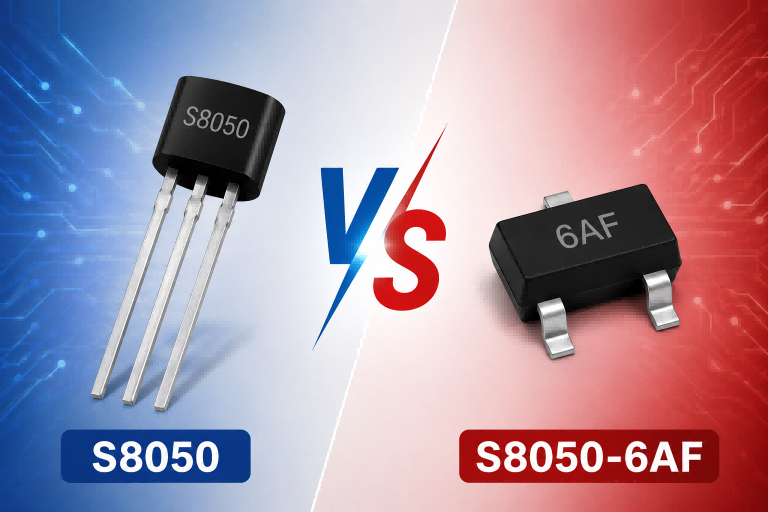
S8050 and S8050-6AF are both NPN bipolar junction transistors (BJTs) commonly used in switching, signal control, and amplification applications. Engineers often compare these two part numbers because they may appear to represent different versions of the same transistor family, while the actual differences are mainly related to package selection and design requirements.
The S8050 is commonly available in traditional through-hole packages such as TO-92, while S8050-6AF is often associated with compact surface-mount packages such as SOT-23. Although they serve similar transistor functions, the package choice can significantly affect PCB footprint, assembly method, and manufacturing efficiency.
Understanding the differences between S8050 and S8050-6AF helps engineers select a suitable component based on their PCB design constraints and production requirements.
Are S8050 and S8050-6AF the Same Type of Transistor?
S8050 and S8050-6AF belong to the same S8050 NPN transistor family and are designed for similar general-purpose applications. Both are commonly used in electronic circuits for functions such as switching control, signal processing, and low-power amplification. From a functional perspective, they are both NPN bipolar junction transistors intended for controlling or amplifying electrical signals.
The difference between these two part numbers mainly comes from the way manufacturers identify and classify their products. S8050 is a general transistor designation widely used by different semiconductor manufacturers. In comparison, the “-6AF” suffix in S8050-6AF is typically a manufacturer-specific identifier, which may represent a particular product version, marking code, gain classification, or other internal specification depending on the supplier.
Therefore, S8050 and S8050-6AF should not be considered completely different types of components. The key difference is not that one is a transistor while the other is not, but that engineers need to verify the exact product specifications before selection. Important factors to check include package information, pin configuration, and electrical characteristics from the manufacturer’s datasheet.
Are S8050 and S8050-6AF the Same Type of Transistor?
S8050 and S8050-6AF belong to the same S8050 NPN transistor family and are designed for similar general-purpose applications. Both are commonly used in electronic circuits for functions such as switching control, signal processing, and low-power amplification. From a functional perspective, they are both NPN bipolar junction transistors intended for controlling or amplifying electrical signals.
The difference between these two part numbers mainly comes from the way manufacturers identify and classify their products. S8050 is a general transistor designation widely used by different semiconductor manufacturers. In comparison, the “-6AF” suffix in S8050-6AF is typically a manufacturer-specific identifier, which may represent a particular product version, marking code, gain classification, or other internal specification depending on the supplier.
Therefore, S8050 and S8050-6AF should not be considered completely different types of components. The key difference is not that one is a transistor while the other is not, but that engineers need to verify the exact product specifications before selection. Important factors to check include package information, pin configuration, and electrical characteristics from the manufacturer’s datasheet.
S8050 vs S8050-6AF: Package Difference and PCB Footprint
One of the main reasons engineers compare S8050 and S8050-6AF is that they are commonly associated with different package formats. Although both belong to the S8050 NPN transistor family, the package style determines how the component is mounted on a PCB and how much physical space it occupies.
S8050: Traditional Through-Hole Package
S8050 is commonly available in traditional through-hole packages such as TO-92. In this type of package, the transistor leads pass through drilled holes on the PCB and are soldered from the opposite side of the board.
Through-hole packages are widely used in conventional electronic designs because they are easy to handle, test, and replace during prototyping or maintenance. However, the package requires dedicated PCB holes and creates a higher component profile above the board surface.
For designs that already use through-hole components or require simple assembly and manual handling, TO-92 remains a practical package option.
S8050-6AF: Compact SMD Package
S8050-6AF is commonly found in compact surface-mount packages such as SOT-23. Unlike through-hole components, SMD devices are mounted directly onto the surface of the PCB without requiring drilled mounting holes.
The smaller package size reduces the physical area occupied by the transistor and allows components to be placed closer together on the PCB. This makes SOT-23 packages suitable for compact circuit designs where board space is limited.
For modern PCB layouts that prioritize smaller dimensions and higher component density, compact SMD packages provide greater flexibility compared with traditional through-hole packages.
S8050 vs S8050-6AF Package Comparison
| Feature | S8050 | S8050-6AF |
|---|---|---|
| Device Type | NPN BJT | NPN BJT |
| Common Package | TO-92 | SOT-23 |
| Mounting Method | Through-hole | Surface Mount |
| PCB Footprint | Larger | Smaller |
| Typical Usage | Traditional PCB designs | Compact PCB designs |
How SMD Packaging Helps Optimize PCB Design
The adoption of SMD packages such as SOT-23 has become an important trend in modern PCB design because electronic products continue to become smaller while requiring more functions. Compared with traditional through-hole components, compact SMD packages provide several advantages in PCB layout and manufacturing.
Smaller Component Footprint
One of the biggest advantages of SOT-23 packaging is the reduced component footprint. Because the component is mounted directly on the PCB surface, it requires less board area compared with larger through-hole packages.
A smaller footprint allows engineers to place more components within the same PCB area, increase component density, and develop smaller electronic products. This is especially valuable for applications such as portable electronics, compact control boards, and space-constrained consumer devices.
Better Compatibility with Automated Manufacturing
SMD packages are designed for modern automated PCB assembly processes. Components in SOT-23 packages can be handled by pick-and-place machines and assembled using reflow soldering processes, making them suitable for high-volume production.
In comparison, traditional TO-92 packages often require more manual handling during assembly. SMD packages provide better compatibility with automated production lines and help manufacturers improve production efficiency and consistency.
Improved PCB Layout Flexibility
Compact packages also provide greater flexibility when designing PCB layouts. Smaller components allow engineers to optimize component placement, create more efficient routing paths, and integrate more functions into limited board space.
For products where size, weight, and internal space are important design factors, SMD packages offer advantages that support higher PCB integration and more compact product designs.
Electrical Performance Comparison: Are S8050 and S8050-6AF Equivalent?
Although S8050 and S8050-6AF are often compared based on their package differences, the package size alone does not determine the actual electrical performance of the transistor. A smaller SMD package does not automatically mean that the component has lower performance, just as a larger through-hole package does not always provide better electrical characteristics.
The actual performance of S8050 and S8050-6AF depends on the manufacturer’s datasheet and the specific product version. Engineers should evaluate the key electrical specifications before selecting a component for a circuit design.
Important parameters to verify include:
| Parameter | Why Verify |
|---|---|
| Collector Current (Ic) | Determines the maximum current capability of the transistor |
| Collector-Emitter Voltage (Vceo) | Defines the voltage tolerance between collector and emitter |
| DC Current Gain (hFE) | Indicates the transistor gain range under specific test conditions |
| Power Dissipation | Shows the thermal capability and maximum power handling |
One important consideration is that different package types may have different thermal characteristics. For example, a compact SOT-23 package may have different heat dissipation limitations compared with a larger TO-92 package. This does not mean one package is always better than the other, but it means engineers need to consider thermal requirements based on the actual application.
When comparing S8050 and S8050-6AF, engineers should not judge equivalence only by appearance or package size. The correct approach is to compare the manufacturer’s datasheet specifications, including electrical ratings, package information, and operating conditions, before making a design decision.
Can S8050 Replace S8050-6AF?
When sourcing electronic components, engineers may wonder whether S8050 can directly replace S8050-6AF or whether the two part numbers can be used interchangeably. The answer depends on the specific application, package design, and electrical requirements of the circuit.
Although both components belong to the S8050 NPN transistor family, they should not be considered direct replacements without verification. Before replacing one with the other, engineers should check the following key factors.
1. Package Compatibility
The first factor to verify is the package type. S8050 is commonly associated with through-hole packages such as TO-92, while S8050-6AF is often available in compact SMD packages such as SOT-23.
Because these packages have different physical structures, they cannot be directly substituted without considering the PCB design and component mounting requirements.
2. Pin Configuration
The pin arrangement must also be confirmed before replacement. Engineers should verify the position of:
- Collector
- Base
- Emitter
Even when two transistors have similar electrical functions, different pin configurations can prevent direct replacement.
3. Electrical Specifications
The electrical characteristics should be compared with the original component requirements. Important specifications include:
- Collector-emitter voltage rating;
- Collector current capability;
- DC current gain requirements.
The replacement component should meet or exceed the requirements of the original design.
4. Application Conditions
The difficulty of replacement also depends on the circuit application. For low-power switching applications, replacing one S8050-family transistor with another similar version may be relatively straightforward after verification.
However, applications involving higher current loads, stricter voltage requirements, or specific gain characteristics require more careful evaluation.
Before using S8050 as a replacement for S8050-6AF, engineers should always confirm the package, pin configuration, and electrical specifications from the manufacturer’s datasheet.
Which One Should You Choose for Your PCB Design?
The choice between S8050 and S8050-6AF depends on the design requirements, PCB structure, and manufacturing needs of your project. Neither option is universally better than the other. The suitable choice depends on whether your priority is easier handling, existing board compatibility, or compact product design.
Choose S8050 When:
S8050 is a practical choice for applications where through-hole components are preferred. It is commonly suitable for:
- Prototype development and circuit testing;
- Breadboard-based experiments;
- Existing through-hole PCB designs;
- Projects where easy manual handling and replacement are important.
For development environments, educational projects, or designs that already use through-hole components, the traditional S8050 package can provide convenience during assembly and testing.
Choose S8050-6AF When:
S8050-6AF is a better fit for compact PCB designs and modern production environments. It is commonly selected for:
- PCB designs with limited available space;
- Products requiring SMT assembly;
- High-volume manufacturing;
- Compact electronic devices where component density is important.
The final decision should consider three factors: PCB design requirements, manufacturing process, and application conditions. Engineers should select the package and component version that best matches the overall system requirements rather than choosing based on the part number alone.
Conclusion
S8050 and S8050-6AF belong to the same NPN transistor family, but the main engineering difference is usually related to package selection. S8050 with a traditional TO-92 package focuses on simplicity and accessibility, while S8050-6AF with a compact SMD package supports space-efficient PCB designs and automated production requirements. Before replacing or selecting either component, engineers should always verify the manufacturer’s datasheet, including package details, pin configuration, and electrical specifications.
FAQs
S8050-6AF and S8050 belong to the same S8050 NPN transistor family, but they are not necessarily identical part numbers. The suffix and package specifications may vary depending on the manufacturer. Engineers should always confirm the actual datasheet information before selection.
S8050 can only replace S8050-6AF after verifying key specifications, including package compatibility, pin configuration, and electrical characteristics. Different package types may require PCB design changes.
SOT-23 is widely used in modern PCB designs because its compact size reduces component footprint and allows higher-density layouts. It is also compatible with automated SMT assembly processes used in many manufacturing environments.
No. S8050-6AF is generally a single NPN bipolar transistor in a compact SMD package. The “-6AF” suffix does not indicate that the device contains multiple transistors or that it is a transistor array. The exact meaning of the suffix depends on the manufacturer’s naming system.