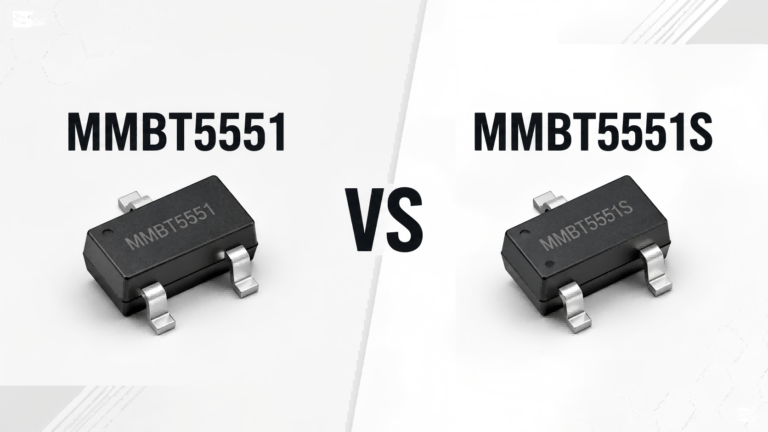
MMBT5551 and MMBT5551S are two part numbers frequently compared when engineers search for high-voltage NPN transistor solutions. Although they appear to belong to the same 5551 transistor family, designers and purchasers often need to confirm whether they are interchangeable, whether there are any meaningful performance differences, and which option is suitable for their circuit requirements.
The difference between these two part numbers is not always determined by the suffix alone. Depending on the manufacturer, product naming conventions and specifications may vary. Therefore, engineers should evaluate key factors beyond the model name, including voltage capability, package compatibility, driving applications, and replacement considerations.
This article compares MMBT5551 and MMBT5551S from an engineering selection perspective to help identify the right component for different designs.
What Is MMBT5551? Overview of the High-Voltage NPN Transistor
MMBT5551 is a high-voltage NPN bipolar transistor designed for small-signal amplification and switching applications. As a member of the 5551 transistor family, it is commonly used when a circuit requires higher voltage capability than standard low-voltage signal transistors while maintaining a compact surface-mount package.
Typical electrical specifications of MMBT5551 include:
| Parameter | Value |
|---|---|
| Transistor Type | NPN BJT |
| Collector-Emitter Voltage (VCEO) | 160V |
| Collector Current (IC) | 600mA |
| Package | SOT-23 |
The reason MMBT5551 is classified as a high-voltage transistor is its higher collector-emitter voltage rating. Compared with many general-purpose small-signal transistors that typically operate at lower voltage levels, MMBT5551 is designed to handle circuits requiring up to 160V between collector and emitter.
This high-voltage capability makes MMBT5551 suitable for high-voltage signal circuits and switching designs where voltage tolerance is an important consideration. At the same time, its SOT-23 package allows designers to integrate the transistor into compact PCB layouts while maintaining compatibility with modern surface-mount manufacturing processes.
When selecting MMBT5551, engineers should consider both electrical specifications and package requirements to ensure proper circuit performance.
MMBT5551 vs MMBT5551S: Are They Electrically Different?
When comparing MMBT5551 and MMBT5551S, the first thing engineers should understand is that the “S” suffix does not always represent a universal industry definition. Semiconductor manufacturers may use suffixes differently depending on their own product naming systems. In some cases, a suffix may indicate a product series, internal code, packaging option, or manufacturer-specific designation.
Therefore, the difference between MMBT5551 and MMBT5551S cannot be determined only by looking at the part number. Engineers should verify the actual specifications from the manufacturer datasheet before making a replacement decision. Important information to check includes the manufacturer, electrical specifications, and official product documentation.
| Item | MMBT5551 | MMBT5551S |
|---|---|---|
| Transistor Type | NPN BJT | Verify by manufacturer |
| Voltage Rating | Check datasheet | Check datasheet |
| Package | Usually SOT-23 | Verify by manufacturer |
| Replacement | Datasheet confirmation required | Datasheet confirmation required |
For component sourcing and circuit replacement, the part number alone is not always enough to determine compatibility. Even if two devices share a similar naming structure, their electrical characteristics, manufacturing specifications, or ordering codes may differ.
The correct approach is to compare the official datasheets and confirm whether the device meets the requirements of the target circuit. This helps avoid replacement issues caused by differences in specifications or manufacturer definitions.
Voltage Capability Comparison: 160V High-Voltage Performance
One of the main reasons engineers consider MMBT5551 is its high-voltage capability compared with many general-purpose small-signal transistors. As a high-voltage NPN bipolar transistor, the MMBT5551 family is designed to handle higher voltage conditions while maintaining the characteristics required for signal-level circuit applications.
The key electrical ratings commonly associated with MMBT5551 include:
| Parameter | Value |
|---|---|
| Collector-Emitter Voltage (VCEO) | 160V |
| Collector Current (IC) | 600mA |
The 160V collector-emitter voltage rating allows MMBT5551 to be used in circuits where higher voltage tolerance is required. Compared with standard low-voltage signal transistors, this higher voltage capability provides additional design flexibility for applications involving higher voltage signals, voltage variations, or industrial control requirements within the specified operating limits.
However, MMBT5551 should not be considered a power transistor. It is designed as a high-voltage small-signal transistor, focusing on signal processing, amplification, and switching functions rather than handling high-power loads.
Typical functions include:
- Voltage amplification in signal circuits
- Signal switching in control circuits
- Interface circuits requiring higher voltage tolerance
Engineers often choose 160V BJT devices like MMBT5551 because they provide a practical balance between voltage capability, cost efficiency, and simple circuit integration. Compared with more complex semiconductor solutions, bipolar transistors can offer straightforward driving requirements and reliable performance for many general-purpose electronic designs.
When selecting a high-voltage transistor, designers should always consider the complete electrical requirements, including voltage rating, current capability, and circuit operating conditions, rather than focusing on voltage rating alone.
Package Comparison: SOT-23 and Other MMBT5551 Variants
Package selection is an important consideration when choosing MMBT5551 series transistors, especially for engineers working on PCB design and manufacturing optimization. The most common package used for MMBT5551 devices is SOT-23, a compact surface-mount package widely adopted in modern electronic assemblies.
The SOT-23 package provides several practical advantages:
- Compact PCB footprint for space-limited designs
- Compatibility with surface mount assembly (SMT) processes
- Support for automated high-volume production
Based on available market variants, MMBT5551 products may be offered by different manufacturers with different package options. Examples include:
| Part Number | Package |
|---|---|
| MMBT5551 | SOT-23 |
| MMBT5551-B | SOT-23 |
| MMBT5551-E | SOT-23 |
| MMBT5551-6AF | SOT-23 |
| MMBT5551-HAF | TO-236-3 |
| MMBT5551-5551 | SOT-89 |
Although many MMBT5551 variants use the same SOT-23 package, engineers should not assume that all versions are mechanically identical. Different package options can affect several aspects of the design, including PCB layout requirements, thermal management considerations, and the overall assembly process.
For replacement or sourcing purposes, verifying the package type is essential before selecting an alternative component. A transistor with the same basic model name may require a different PCB footprint or manufacturing approach if it uses another package style.
Therefore, package compatibility should always be evaluated together with manufacturer specifications to ensure smooth integration into the target production process.
Driving Applications: Where Are MMBT5551 Transistors Used?
MMBT5551 transistors are widely used in electronic designs that require high-voltage signal control, switching capability, and general-purpose amplification. As a high-voltage small-signal NPN transistor, MMBT5551 is typically used as a control or signal-processing component rather than a device for directly driving high-power loads.
1. High Voltage Switching
One common application of MMBT5551 is high-voltage switching in electronic circuits. It can function as a switching element in circuits where a control signal needs to manage a higher-voltage path.
Typical uses include:
- Switching circuits
- Interface circuits
- Control signal switching
In these designs, MMBT5551 helps transfer or control signals between different circuit sections while providing higher voltage tolerance compared with many standard low-voltage transistors.
2. Driver Circuits
MMBT5551 can also be used in various driver circuits where a low-level control signal needs amplification before controlling a small load.
Examples include:
- Relay driver circuits
- LED control circuits
- Small load switching applications
However, it is important to understand that MMBT5551 is mainly used for signal amplification and control functions. It is not intended to directly replace power MOSFETs or power transistors in applications requiring high current delivery or large power handling capability.
3. Amplification Circuits
As a bipolar transistor, MMBT5551 can be used in analog circuits requiring signal amplification.
Common examples include:
- Audio circuits
- Analog signal amplification stages
- General-purpose amplifier designs
Its characteristics make it suitable for processing and amplifying electrical signals where voltage capability is an important design consideration.
4. Industrial Electronics
MMBT5551 is also found in industrial electronic equipment, including:
- Control systems
- Instrumentation circuits
- Electronic interfaces
In these applications, engineers often select MMBT5551 because it provides a combination of voltage tolerance, compact implementation, and reliable switching or amplification performance for signal-level circuits.
When designing with MMBT5551, the transistor should be selected based on the specific circuit requirements, including switching conditions, signal levels, and operating environment.
How to Select a Replacement for MMBT5551 or MMBT5551S?
Selecting a replacement for MMBT5551 or MMBT5551S requires more than simply matching the part number. Although two transistors may appear similar in naming, engineers need to verify several key specifications to ensure electrical and mechanical compatibility with the original design.
A proper replacement evaluation should include the following checks:
1. Electrical Parameters
The first step is to compare the main electrical characteristics, including:
- Collector-Emitter Voltage (VCEO)
- Collector Current (IC)
- DC Current Gain (hFE)
These parameters determine whether the replacement transistor can operate correctly under the required circuit conditions. A replacement with different electrical ratings may affect circuit reliability or performance.
2. Package Compatibility
The physical package must match the PCB design or manufacturing requirements. Common package options for MMBT5551 series devices include:
- SOT-23
- SOT-89
- TO-236-3
Different packages may require different PCB footprints and assembly processes, so package verification is essential before replacement.
3. Pin Configuration
Pin assignment is another important factor when replacing surface-mount transistors. SMD transistor pinouts can vary between manufacturers, even when devices share similar part numbers or package styles.
Engineers should verify:
- Collector pin location
- Base pin location
- Emitter pin location
before using a replacement component in production.
4. Manufacturer Datasheet Verification
The final decision should always be based on the official manufacturer datasheet. Datasheets provide the most reliable information about electrical ratings, package dimensions, pin configuration, and operating conditions.
By checking electrical parameters, package compatibility, pin configuration, and manufacturer documentation, engineers can select a suitable replacement for MMBT5551 or MMBT5551S while reducing risks during circuit modification or component sourcing.
MMBT5551 Series Available Options
The MMBT5551 series is available from multiple semiconductor manufacturers, providing engineers and purchasers with different sourcing options based on application requirements, production needs, and supply availability. While the basic transistor family remains the same, different manufacturers may offer variations in package options, gain ranges, and product specifications.
CNCHIPDEPOT provides multiple MMBT5551 variants from different suppliers, including:
| Manufacturer | Available Options |
|---|---|
| Agertech | MMBT5551 |
| BLUE ROCKET | MMBT5551-B |
| CJ (Jiangsu Changdian/Changjing) | MMBT5551 with different gain ranges |
| GME (Galaxy Microelectronics) | MMBT5551 100-200 / 200-300 |
| MDD Semiconductor | MMBT5551-E |
| FOSAN | MMBT5551-6AF |
These options allow customers to select suitable components based on factors such as manufacturer preference, availability, electrical requirements, and production compatibility.
For engineers replacing existing components or managing large-volume procurement, having access to multiple MMBT5551 sources can improve supply flexibility and reduce dependency on a single manufacturer. CNCHIPDEPOT supports sourcing of MMBT5551 series transistors with different manufacturers, gain ranges, and package options to meet various electronic design and manufacturing requirements.
FAQs
MMBT5551S may be considered a replacement for MMBT5551 in some applications, but compatibility should not be determined only by the suffix. The “S” designation can have different meanings depending on the manufacturer. Engineers should compare the official datasheet, electrical parameters, package type, and pin configuration before selecting MMBT5551S as an alternative.
MMBT5551 is a high-voltage NPN transistor typically rated with a collector-emitter voltage (VCEO) of 160V. This higher voltage capability makes it suitable for signal circuits and switching applications that require greater voltage tolerance than standard low-voltage transistors. The actual operating voltage should always remain within the manufacturer’s specified limits.
No. MMBT5551 is not a power transistor. It is a high-voltage small-signal NPN bipolar transistor designed for amplification and switching functions. While it can handle higher voltage levels, it is mainly used for signal control, voltage amplification, and low-power switching applications rather than directly driving high-power loads.
MMBT5551 is commonly available in the SOT-23 surface-mount package, which is widely used for compact PCB designs and automated assembly. However, different manufacturers may provide other package options, such as TO-236-3 or SOT-89. Engineers should verify the exact package and footprint before selecting a specific variant.
To verify MMBT5551 replacement compatibility, engineers should check four key factors: electrical parameters, package type, pin configuration, and manufacturer datasheet information. Important specifications include VCEO, IC, and hFE values. Even if two components share similar names, differences in pinout or package design may affect whether they can be used as direct replacements.