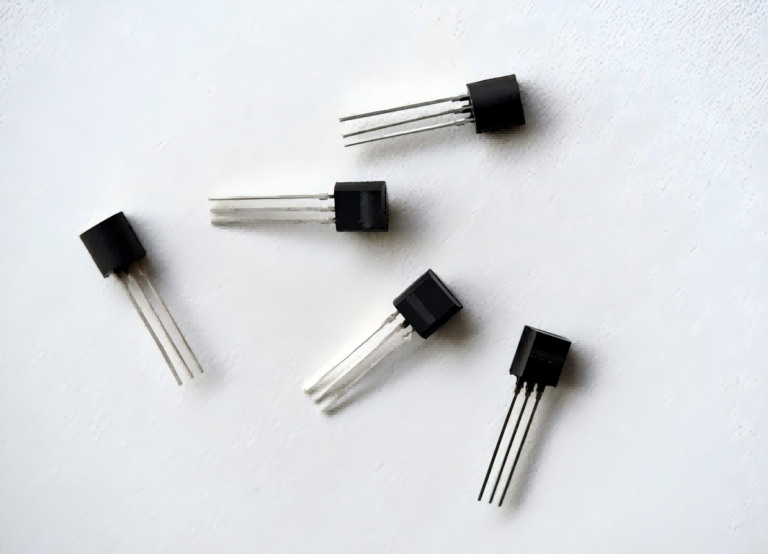
When designing audio amplifiers, microphone preamplifiers, or phono stages, engineers need to select bipolar transistors that can amplify weak signals while introducing minimal noise.
Although choosing a low noise transistor may seem straightforward, practical designs often involve different recommendations, from dedicated low noise BJTs and classic audio transistors to specialized switching devices. This is because noise performance depends on more than datasheet specifications alone.
Factors such as source impedance, voltage noise, current noise, operating current, and circuit configuration all influence the final result. A transistor that performs well in an MC phono preamplifier may not be the best choice for another application.
This article explains how to choose the right low noise BJT for different audio circuits and why some unexpected transistor types can deliver excellent performance.
Is There a Best Low Noise Bipolar Transistor for Audio?
A common question among audio designers is:
What is the lowest noise bipolar transistor for audio applications?
The short answer is that there is no single transistor that provides the lowest noise performance in every circuit.
A low noise BJT must be matched to the electrical conditions of the application. The same transistor can perform differently depending on:
- Signal source impedance
- Required gain
- Operating current
- Frequency range
- Circuit topology
For example, a transistor optimized for a very low impedance source, such as a moving-coil cartridge or dynamic microphone, may not provide the best performance in a high impedance input circuit.
This is why experienced designers often avoid ranking transistors simply by one specification such as noise figure. Instead, they evaluate the complete noise behavior of the transistor inside the intended circuit.
A useful way to think about low noise transistor selection is:
The best transistor is not the one with the lowest noise number. It is the one whose noise characteristics best match the circuit requirements.
Why Noise Figure Alone Does Not Tell the Full Story
Datasheets often provide a typical noise figure value, but this number is measured under specific test conditions. The result may not represent the actual noise performance in a real audio circuit.
For bipolar transistors, noise performance is mainly influenced by:
- Input voltage noise
- Input current noise
- Base spreading resistance
- Collector current
A transistor with a very low voltage noise may perform well with a low impedance signal source, while another transistor with lower current noise may be better for higher impedance applications.
Therefore, comparing only the noise figure value between different BJTs can lead to incorrect conclusions.
What Makes a Bipolar Transistor Low Noise?
The low noise characteristics of a bipolar transistor come from several internal factors. Understanding these factors helps explain why some devices are preferred for sensitive audio applications.
Transistor Voltage Noise
Voltage noise represents the unwanted voltage fluctuations generated internally by the transistor. It is especially important when the transistor is connected to a low impedance signal source.
Applications where voltage noise is critical include:
- Moving-coil (MC) phono preamplifiers
- Dynamic microphone preamplifiers
- Low impedance audio input stages
For these applications, designers often look for transistors with very low input-referred voltage noise.
Transistor Current Noise
Current noise becomes more important when the signal source has a higher impedance.
A transistor input current creates noise when flowing through the impedance connected to the base terminal. Therefore, a transistor with higher current noise may perform poorly in high impedance circuits even if its voltage noise specification looks excellent.
This explains why a transistor that is excellent for one audio application may not be suitable for another.
Base Spreading Resistance (Rbb’) and Noise Performance
One of the most important factors in low noise BJT design is base spreading resistance, commonly represented as Rbb’.
The base region inside a transistor has unavoidable resistance. This resistance generates thermal noise, which appears as additional input voltage noise.
Reducing Rbb’ can significantly improve noise performance, especially in low impedance applications.
This is one reason why some transistor designs originally created for fast switching applications can perform very well in audio circuits. A low base resistance helps the transistor respond quickly during switching, but it can also reduce noise in sensitive amplifier stages.
Why Are Some Switching Transistors Used as Low Noise Audio BJTs?
One of the most interesting discussions among audio engineers is why certain switching transistors are recommended for low noise audio applications.
At first glance, this seems counterintuitive. Many engineers assume that switching transistors are designed only for digital or power switching circuits and are not suitable for precision analog applications.
However, some switching transistors have characteristics that make them excellent low noise devices.
The most commonly discussed examples include ZTX951 and ZTX851.
These devices are known for:
- Very low base spreading resistance
- Low voltage noise
- High performance in low impedance input stages
Their original purpose was fast switching, but the same structural characteristics that improve switching speed can also benefit low noise amplifier designs.
For example, low base resistance helps reduce the voltage noise contribution at the transistor input. This makes devices such as ZTX951 and ZTX851 attractive for applications like:
- Moving-coil phono preamplifiers
- Dynamic microphone preamplifiers
- Low impedance audio input stages
However, this does not mean every switching transistor is automatically a low noise transistor. The performance depends on the internal transistor structure and electrical characteristics.
The important lesson is:
A transistor designed for switching is not necessarily noisy. Some switching transistors achieve excellent analog performance because of their low internal resistance.
How Source Impedance Determines the Right Low Noise Transistor
When selecting a low noise bipolar transistor, the first question should not be:
“Which transistor has the lowest noise?”
The better question is:
“What is the impedance of the signal source connected to the transistor input?”
The source impedance determines whether voltage noise or current noise has a greater impact.
Low Impedance Sources
Low impedance applications include:
- Moving-coil (MC) cartridges
- Dynamic microphones
- Certain audio sensor inputs
In these circuits, voltage noise is usually the dominant concern.
A transistor with low base spreading resistance and low voltage noise is often preferred.
Devices such as ZTX951 and ZTX851 are frequently discussed for these applications because they provide excellent voltage noise performance at appropriate operating currents.
Higher Impedance Sources
Higher impedance applications require more attention to current noise.
Examples include:
- Moving-magnet (MM) cartridge inputs
- High impedance sensor interfaces
- Certain instrument amplifier inputs
In these situations, a transistor with extremely low voltage noise may not always provide the best overall noise performance because input current noise can become significant.
This is also why some engineers choose JFET input devices for high impedance applications.
Why Operating Current Matters
The noise performance of a bipolar transistor also changes with collector current.
A transistor may have an optimum operating point where voltage noise and current noise contributions are balanced.
Therefore, selecting a transistor is not only about the device itself. The surrounding circuit design, including bias current and source impedance, also determines the final noise performance.
Recommended Low Noise Bipolar Transistors for Audio Applications
After understanding how transistor noise works and why source impedance affects the final result, the next question is usually:
Which low noise bipolar transistors are commonly used in audio circuits?
There is no universal ranking of the “best” devices, but several BJTs are widely recognized for low noise performance in specific applications.
The following devices are commonly discussed among audio engineers and electronics designers:
| Transistor | Type | Main Characteristics | Typical Audio Applications |
|---|---|---|---|
| ZTX951 | NPN | Extremely low voltage noise, very low base spreading resistance | MC phono preamplifiers, dynamic microphone preamplifiers |
| ZTX851 | PNP | Complementary device to ZTX951 with similar low noise characteristics | Low noise complementary amplifier stages |
| BC550C | NPN | General-purpose low noise transistor with high gain | Audio preamplifiers, small signal amplifier stages |
| BC560C | PNP | Complementary low noise version of BC550C | Audio amplifier input stages |
| KSC1845 | NPN | Low noise transistor commonly used in modern audio designs | Differential input stages, audio amplifiers |
| KSA992 | PNP | Complementary pair with KSC1845 | Low noise amplifier input circuits |
| 2SC2240 | NPN | Classic Japanese low noise audio transistor | Audio preamplifiers and amplifier circuits |
| MPSA18 | NPN | High gain small signal transistor with low noise characteristics | Small signal amplification applications |
ZTX951 and ZTX851: Low Noise Devices for Low Impedance Sources
Among audio enthusiasts, ZTX951 and ZTX851 are often mentioned as exceptional low noise bipolar transistors.
Their advantage comes mainly from extremely low base spreading resistance, which helps achieve very low input voltage noise.
They are especially suitable for applications where the source impedance is low, such as:
- Moving-coil cartridge preamplifiers
- Dynamic microphone preamplifiers
- Low impedance audio input stages
However, these devices are not automatically the best choice for every circuit.
Because current noise also affects total input noise, designers need to consider the complete source impedance and circuit conditions before selecting them.
BC550C and BC560C: General Purpose Low Noise Audio BJTs
The BC550C and BC560C are among the most widely recognized low noise audio transistors.
They are popular because they provide a practical balance between:
- Low noise performance
- High DC gain
- Easy availability
- Simple circuit integration
Compared with specialized ultra-low-noise devices, BC550C and BC560C may not achieve the absolute lowest noise in demanding applications such as MC phono stages.
However, they are often suitable for:
- General audio preamplifiers
- Small signal amplifier stages
- Audio equipment input circuits
For many standard audio designs, these devices provide sufficient noise performance without requiring specialized components.
KSC1845 and KSA992: Modern Replacements for Classic Audio BJTs
Many classic low noise Japanese transistors have become difficult to source due to discontinuation or limited availability.
As a result, modern alternatives such as KSC1845 and KSA992 are frequently considered for audio amplifier designs.
These complementary transistor pairs are commonly used in:
- Differential input stages
- Audio power amplifier circuits
- Low noise voltage amplification stages
When replacing older devices, engineers should verify:
- Voltage rating
- Pin configuration
- Gain range
- Package type
- Noise specifications
A replacement transistor should not be selected only because it has a similar part number.
2SC2240 and Other Classic Low Noise Audio Transistors
The 2SC2240 is a well-known Japanese low noise NPN transistor used in many audio circuits.
It has historically been popular in:
- Audio preamplifiers
- Amplifier input stages
- High-quality consumer audio equipment
However, because many classic Japanese transistor models are no longer widely manufactured, engineers often need to consider modern alternatives.
When sourcing older transistor types, verifying authenticity and supply reliability is important because counterfeit components can create unexpected noise or reliability problems.
Choosing the Right Low Noise BJT for Different Audio Applications
Different audio circuits have different noise requirements. Instead of choosing a transistor only by reputation, it is better to match the device to the application.
| Application | Main Requirement | Common Choices |
|---|---|---|
| Moving-coil (MC) phono preamp | Extremely low voltage noise, low base resistance | ZTX951, ZTX851 |
| Dynamic microphone preamp | Low input voltage noise | ZTX951, ZTX851, low noise BJTs |
| General audio preamp | Balanced noise, gain, availability | BC550C, BC560C |
| Audio amplifier differential input | Low noise matching pair | KSC1845, KSA992 |
| Small signal amplifier circuits | High gain with low noise | MPSA18, BC series devices |
BJT vs JFET for Low Noise Audio Applications
Although this article focuses on bipolar transistors, JFETs are also widely used in low noise amplifier designs.
The choice between BJT and JFET depends mainly on signal source characteristics.
| Feature | BJT | JFET |
|---|---|---|
| Voltage noise | Usually excellent for low impedance sources | Also very low in selected devices |
| Current noise | Higher input current compared with JFET | Usually lower current noise |
| Input impedance | Medium | Very high |
| Suitable applications | Microphone, MC cartridge, low impedance sources | High impedance sensors, pickups, special input stages |
For low impedance sources, BJTs often provide excellent voltage noise performance.
For high impedance sources, JFETs may provide advantages because their low input current reduces current noise effects.
Therefore, neither technology is universally better. The correct choice depends on the complete circuit design.
Low Noise Transistor Selection Guide by Application
Selecting a low noise transistor for a real production design requires more than choosing a device with the lowest noise specification. In engineering projects, the final component decision usually involves balancing electrical performance, availability, reliability, and long-term supply considerations.
Before selecting a transistor for production, engineers should evaluate several practical factors:
- Electrical compatibility: Verify key parameters such as voltage rating, collector current, gain range, noise characteristics, and operating conditions to ensure the transistor matches the circuit requirements.
- Package and PCB compatibility: Even when two transistors have similar electrical characteristics, differences in package type, pin configuration, or mounting method can affect whether they can be used as direct replacements.
- Component availability and supply stability: Some classic low noise audio transistors are no longer widely manufactured, making sourcing and replacement planning important for long-term projects.
- Authenticity and quality control: For sensitive audio circuits, counterfeit or inconsistent components can significantly affect noise performance and reliability. Working with verified supply channels helps reduce these risks.
For engineers developing audio equipment, microphone systems, industrial electronics, or other low signal applications, transistor selection is often an engineering decision rather than a simple product search. A suitable device must provide the required noise performance while also meeting production requirements.
When original components are unavailable or discontinued, engineers may need to evaluate alternative BJTs with similar electrical characteristics. This process usually requires comparing datasheets, package information, operating conditions, and application requirements.
China Chip Depot supports transistor sourcing for different electronic applications, including BJT selection, replacement components, and production supply requirements. Engineers can work with available transistor options based on electrical specifications, package requirements, and application scenarios to identify suitable components before moving into production.
FAQs
There is no single quietest bipolar transistor for every audio application. The best choice depends on source impedance, required noise performance, and circuit conditions. Devices such as ZTX951, ZTX851, BC550C, KSC1845, and 2SC2240 are commonly considered for low noise audio designs.
Some switching transistors can provide excellent low noise performance. Devices such as ZTX951 and ZTX851 are examples where low internal base resistance contributes to very low voltage noise.
BC550C is a reliable general-purpose low noise audio transistor, but it is not always the best choice for every circuit. Specialized devices may provide better performance in applications requiring extremely low noise.
The choice depends mainly on source impedance. BJTs are often preferred for low impedance sources because of their low voltage noise, while JFETs are often suitable for high impedance sources because of their low input current.