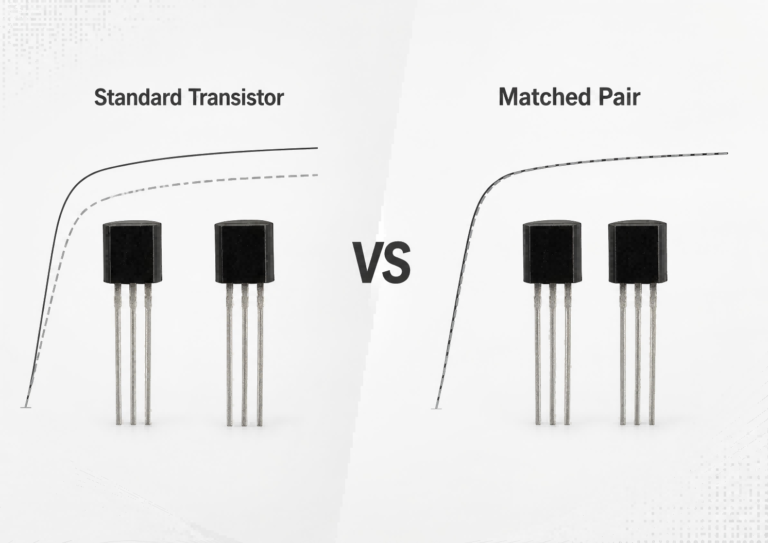
In precision analog circuits, using two transistors with the same part number does not always guarantee identical performance. Small differences in electrical characteristics can introduce errors in circuits where balance and stability are important. This is why engineers use matched transistor pairs.
However, many engineers still wonder why matching is necessary, whether a dual transistor array is the same as a matched pair, and when a matched transistor is actually required. This article explains how transistor matching works, why it matters, and how to determine whether your application needs matched devices.
Why Do Transistors Need to Be Matched?
At first glance, matching two transistors may seem unnecessary. If two devices have the same part number, such as two 2N3904 or 2N3906 transistors, it is reasonable to assume that their behavior should be nearly identical.
In practice, semiconductor manufacturing always introduces small variations. Even transistors produced from the same production batch can have differences in key electrical characteristics, including:
- Base-emitter voltage (VBE)
- Current gain (hFE or β)
- Collector current characteristics
- Temperature behavior
For many applications, these variations are insignificant. A switching circuit or a general-purpose amplifier may work perfectly well with standard transistors.
The situation changes in precision analog circuits. When two transistors are used together as a differential pair, current mirror, or other balanced circuit structure, even small differences can affect circuit performance.
For example, in a differential amplifier, two input transistors are expected to respond equally when the input signals are the same. If one transistor has a slightly different VBE value, it may conduct more current than the other device, creating an unwanted offset voltage.
This is the fundamental reason matched transistors exist:
Matching reduces the electrical differences between two transistors so that precision analog circuits can operate more accurately and consistently.
What Is a Matched Transistor Pair?
A matched transistor pair is a set of two transistors that have been selected or manufactured to achieve closely similar electrical characteristics.
Unlike ordinary transistor pairs that only share the same part number, matched transistors are evaluated based on specific parameters that affect circuit balance.
The most important matching characteristics include:
| Matching Parameter | Meaning | Why It Matters |
|---|---|---|
| VBE matching | Difference in base-emitter voltage between two transistors | Reduces input offset and improves circuit balance |
| hFE matching | Similarity of transistor current gain | Helps maintain consistent current behavior |
| Thermal matching | Similar temperature response between devices | Improves stability during temperature changes |
| Current matching | Similar collector current performance | Important for current mirrors and precision circuits |
For bipolar junction transistors (BJTs), VBE matching is often one of the most important specifications.
A small VBE difference can cause unequal collector currents when two transistors operate under the same conditions. In precision circuits, this mismatch can be amplified and become a noticeable error.
This is why matched bipolar transistor pairs are commonly used in circuits where two devices must behave as closely as possible.
How Are Transistors Matched?
There are two common approaches to creating matched transistor pairs: manufacturing matched devices directly or manually selecting devices through testing.
Monolithic Matched Transistors
Monolithic matched transistors are manufactured using semiconductor processes that place two transistor structures close together on the same silicon die.
Because the devices are created under nearly identical conditions, they can achieve excellent matching characteristics and better thermal tracking.
Advantages include:
- Better long-term stability
- Improved temperature consistency
- More predictable electrical performance
These devices are commonly used in precision analog applications where long-term accuracy is important.
Hand-Matched Transistor Pairs
Another approach is selecting individual transistors from a larger production batch and measuring their characteristics.
Engineers may test multiple standard BJTs, compare parameters such as VBE, and select two devices with similar performance.
For example, designers working on analog audio or synthesizer circuits may purchase multiple standard transistors and measure them to find closely matched pairs.
Common devices used for manual matching include general-purpose BJTs such as 2N3904 or 2N3906. The process does not change the transistor itself; it simply identifies devices with similar characteristics.
Hand matching can be useful for prototypes, DIY electronics, and applications where a dedicated matched transistor product is unavailable.
Matched Transistor vs Dual Transistor Array: Are They the Same?
One of the most common questions from engineers is:
If two transistors are already placed inside the same package, why do I still need matched transistors?
The answer is that a dual transistor array and a matched transistor pair solve different problems.
A dual transistor array usually means that two transistor dies are packaged together in a single component. This provides convenience and may improve thermal proximity because both devices experience similar environmental conditions.
However, being placed in the same package does not automatically mean the two transistors have been selected for tight electrical matching.
A matched transistor pair specifically focuses on electrical similarity, such as VBE and gain matching.
| Feature | Dual Transistor Array | Matched Transistor Pair |
|---|---|---|
| Main purpose | Package two transistors together | Ensure similar electrical characteristics |
| Same package | Yes | Usually yes, but not the defining feature |
| VBE matching specification | Not always guaranteed | Usually specified |
| Gain matching | Not necessarily controlled | Often controlled |
| Thermal proximity | Improved | Usually optimized |
| Precision analog use | Depends on device specification | Designed for balanced circuits |
Therefore, a dual transistor array may be useful in some designs, but it should not automatically be considered a replacement for a matched transistor pair.
Engineers should always compare the actual datasheet specifications, including matching tolerance and application requirements.
When Are Matched Transistors Used?
Matched transistors are mainly used when circuit performance depends on two transistor devices behaving almost identically.
The most common applications include differential amplifiers, current mirrors, precision analog circuits, and audio-related designs.
Differential Amplifier Circuits
Differential amplifiers rely on two transistors working together to compare two input signals.
If the two transistors have different electrical characteristics, the circuit may generate unwanted offset voltage even when both inputs are equal.
Using a matched transistor pair helps:
- Reduce input offset
- Improve signal accuracy
- Increase circuit stability
This is one of the most important applications for matched bipolar transistor pairs.
Current Mirror Circuits
Current mirrors use transistor pairs to replicate a reference current.
For accurate current copying, both transistors need similar electrical behavior.
Mismatch can cause:
- Incorrect output current
- Reduced precision
- Temperature-related drift
Matched transistors improve current consistency, especially in precision analog designs.
Audio and Synthesizer Circuits
Matched transistors are also widely discussed in audio electronics and DIY synthesizer communities.
In circuits such as voltage-controlled oscillators (VCOs) and voltage-controlled amplifiers (VCAs), transistor matching helps maintain:
- Stable frequency response
- Lower distortion
- Better tracking accuracy
For example, analog synthesizer designs often require closely matched transistor pairs because small differences can affect pitch accuracy and circuit behavior.
Matched Transistor vs Normal Transistor: Do You Really Need One?
Although matched transistors provide better consistency, they are not required for every circuit design.
A common misunderstanding is that a matched transistor is simply a higher-performance version of a standard transistor. In reality, matching does not necessarily mean higher voltage capability, higher current rating, or faster switching speed.
The main difference is consistency between two devices.
A standard transistor is usually selected based on its individual electrical specifications. A matched transistor pair is selected or manufactured so that two transistors behave more similarly when operating together.
| Feature | Standard Transistor | Matched Transistor Pair |
|---|---|---|
| Electrical consistency | Normal production tolerance | Tightly controlled between devices |
| VBE difference | May vary between devices | Reduced and specified |
| Current gain variation | Normal variation | More closely matched |
| Cost | Lower | Higher |
| Precision analog performance | General-purpose applications | Precision applications |
For many circuits, using standard transistors is completely acceptable.
Applications such as:
- General switching circuits
- Simple transistor amplifiers
- Basic control circuits
usually do not require matched devices.
However, matched transistor pairs become valuable when small differences can create measurable errors, including:
- Precision differential amplifiers
- Analog measurement circuits
- Current mirrors
- Low-offset signal processing circuits
- Certain audio and synthesizer applications
The decision is not whether matched transistors are always better, but whether the circuit performance depends on transistor-to-transistor consistency.
Can You Match Standard Transistors Yourself?
In some situations, engineers can create their own matched transistor pairs by testing multiple standard devices.
The general process is:
- Select multiple transistors from the same family.
- Build a test circuit with controlled operating conditions.
- Measure parameters such as VBE or gain.
- Select two devices with similar results.
This approach has been used for decades, especially in DIY electronics and analog circuit projects.
For example, designers may purchase a group of standard NPN or PNP transistors and select devices with similar VBE values for a specific application.
However, manual matching has limitations:
- Matching quality depends on the test method.
- Temperature changes can affect measurement results.
- Long-term thermal tracking may not equal dedicated matched devices.
- Testing requires additional time and equipment.
For prototypes or hobby projects, manual matching may be sufficient. For production designs requiring stable performance, manufacturers often prefer dedicated matched transistor products.
How to Select a Matched Transistor Pair
Choosing a matched transistor pair requires more than simply searching for two identical transistor numbers.
Engineers should consider several factors depending on the circuit requirements.
Check the Matching Specifications
The most important specifications are related to how closely the two transistors behave.
Common parameters include:
- VBE matching tolerance
- hFE matching
- Thermal tracking characteristics
- Collector current matching
For precision circuits, a tighter matching specification generally provides better performance.
Consider the Transistor Type
Matched transistor pairs are usually available in different configurations, including:
- Matched NPN transistor pairs
- Matched PNP transistor pairs
- Complementary transistor pairs
The correct choice depends on the circuit topology.
For example:
- Differential input stages may use matched NPN or PNP pairs depending on the design.
- Complementary circuits may require matched NPN and PNP characteristics.
Match the Device to the Application
The required matching level depends heavily on the circuit.
| Application | Important Matching Requirement |
|---|---|
| Differential amplifier | Low VBE mismatch and low offset |
| Current mirror | Accurate current matching |
| Audio circuits | Low distortion and stable behavior |
| Synthesizer circuits | Stable tracking and predictable response |
| General amplification | Often does not require tight matching |
Conclusion
Matched transistors are not designed to replace ordinary transistors in every application. Their purpose is to solve a specific engineering problem: reducing differences between two transistor devices when circuit accuracy depends on their similarity.
The most important concepts to remember are:
- Same part number does not always mean identical behavior.
- Matching mainly improves consistency, not basic transistor capability.
- VBE, gain, and thermal characteristics are key matching parameters.
- Differential amplifiers and current mirrors are among the most common applications.
- Dual transistor arrays and matched transistor pairs are not always the same.
- The right choice depends on the circuit requirements, not simply the component type.
For engineers sourcing BJTs and evaluating replacement options, reviewing electrical specifications, package compatibility, and application requirements is essential. China Chip Depot supports transistor sourcing and component selection for different electronic applications, including BJT transistor requirements.
FAQs
No. Two transistors with the same part number meet the same datasheet specifications, but they can still have differences in VBE, gain, and temperature behavior. A matched transistor pair is specifically selected or manufactured to reduce these differences.
Not necessarily. A dual transistor array places two transistors in the same package, but it does not always guarantee tight electrical matching. Engineers should check the datasheet for actual matching specifications.
Sometimes. For many general-purpose circuits, standard transistors are sufficient. Matched pairs are mainly needed when transistor differences can affect precision, balance, or stability.
The additional cost usually comes from tighter manufacturing control, testing, and selection processes required to achieve closer electrical matching.