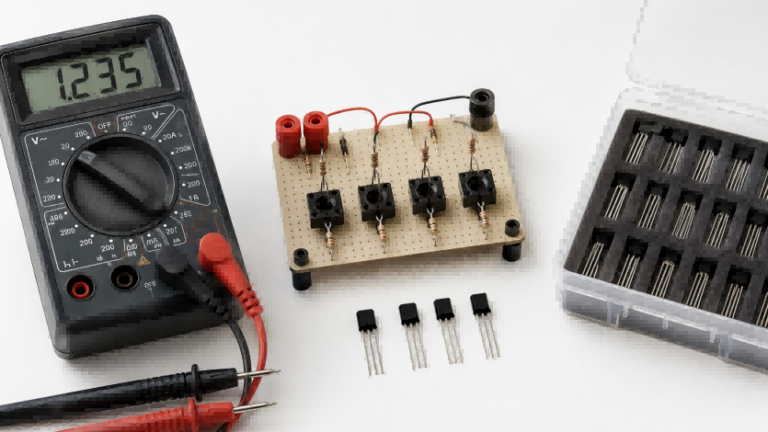
When designing analog circuits, engineers and DIY electronics enthusiasts often discover that two transistors with the same part number may not behave exactly the same. Small differences in electrical characteristics can affect circuit balance, offset voltage, noise performance, or distortion in sensitive applications.
However, transistor matching is not required for every circuit. The key is understanding when matching matters, which parameters need to be compared, and how closely two devices need to match for a specific application.
This guide explains the practical principles behind transistor matching, including matching parameters, testing methods, accuracy requirements, and when using factory-selected matched transistor pairs may be a better choice.
Do You Really Need to Match Transistors?
A common misunderstanding is that every transistor used in a circuit should be matched. In reality, most standard transistor applications can operate correctly without carefully selecting devices.
For circuits such as switching applications, general-purpose amplification, or designs with sufficient feedback and tolerance margins, normal production variation between transistors usually does not create a meaningful performance issue.
Transistor matching becomes important when a circuit relies on two or more transistors behaving almost identically. These circuits are sensitive to small differences in electrical characteristics and may experience performance problems if the devices are significantly different.
Typical applications where transistor matching is important include:
- Differential amplifier input stages
- Precision analog circuits
- Current mirrors
- Low-noise audio circuits
- Analog synthesizer modules such as VCA and filter circuits
- Parallel transistor configurations for current sharing
For example, in a differential pair, two transistors work together to process a signal. If their characteristics are different, the circuit may develop input offset voltage or an imbalance between the two transistor branches.
Therefore, the first question is not “How do I match transistors?” but rather:
Does my circuit actually require matched transistors?
Understanding this distinction prevents unnecessary testing and component selection.
What Does Transistor Matching Actually Mean?
Transistor matching means selecting two or more transistors with closely similar electrical characteristics so they respond in a similar way under the same operating conditions.
Although two transistors may share the same:
- Part number
- Manufacturer
- Package type
- Production batch
they are not guaranteed to have identical electrical behavior.
During semiconductor manufacturing, small variations occur in:
- Silicon material properties
- Manufacturing process conditions
- Device geometry
- Internal transistor characteristics
As a result, parameters such as voltage drop, current gain, and leakage current can vary between individual devices.
A matched transistor pair is therefore not simply two identical-looking components. It is a pair that has been selected based on measured electrical similarity.
For example, two devices labeled with the same transistor model may have slightly different:
- Base-emitter voltage (VBE)
- DC current gain (hFE)
- Leakage current
- Temperature response
In circuits where these differences affect performance, engineers select devices with closer characteristics.
This is why transistor matching is commonly used in precision analog designs rather than ordinary digital or switching circuits.
Which Transistor Parameters Need to Be Matched?
Not every transistor specification needs to be identical. The most important parameter depends on the circuit design and operating conditions.
The commonly considered matching parameters include:
| Parameter | Why It Matters | Typical Applications |
|---|---|---|
| VBE (Base-emitter voltage) | Affects current balance and input offset | Differential pairs, precision analog circuits |
| hFE (DC current gain) | Determines relationship between base current and collector current | Gain stages, some amplifier designs |
| Leakage current | Important when very small currents are involved | Low-current and high-precision circuits |
| Thermal characteristics | Ensures devices respond similarly to temperature changes | Matched pairs, temperature-sensitive circuits |
VBE Matching
Base-emitter voltage matching is one of the most common methods used for transistor matching, especially in differential pair applications.
A small difference in VBE between two transistors can cause different collector currents even when the devices are placed in the same circuit. This imbalance can increase offset voltage and reduce circuit accuracy.
For this reason, many transistor matching methods focus on comparing VBE under a controlled current condition.
hFE Matching
hFE, also called DC current gain, is another commonly measured transistor parameter.
A transistor with a higher hFE can produce a different collector current compared with another transistor under similar conditions. However, whether hFE matching is critical depends on the circuit design.
In many precision analog circuits, VBE matching and thermal behavior may be more important than simply selecting transistors with identical gain values.
For example, two transistors with similar hFE values may still have different temperature behavior, while two devices with slightly different hFE values may perform well if the circuit design compensates for gain variation.
Thermal Matching
Transistor matching is not only about electrical values measured at room temperature.
Temperature has a significant influence on transistor behavior. Two transistors may initially show similar characteristics but drift apart if they operate at different temperatures.
This is why some matched transistor pairs are:
- Placed close together on the PCB
- Mounted in the same package
- Physically attached together
Maintaining similar thermal conditions helps the devices continue behaving as a matched pair during operation.
How Close Should Matched Transistors Be?
One of the most common questions about transistor matching is:
How close do two transistors need to be before they are considered matched?
There is no universal matching tolerance. The required accuracy depends on the circuit application.
A transistor pair suitable for a hobby project may not meet the requirements of a precision measurement circuit.
The required matching level depends on factors such as:
- Circuit topology
- Required accuracy
- Operating current
- Temperature stability
- Acceptable offset or distortion
Examples:
| Application | Typical Matching Consideration |
|---|---|
| DIY synthesizer circuits | Often focused on close VBE matching |
| Audio differential input stages | Requires better matching to reduce offset and distortion |
| Precision analog circuits | Requires tighter electrical matching |
| General transistor circuits | Matching may not be necessary |
Another common question is:
How many transistors do I need to buy to find a matched pair?
The answer depends on the transistor type and the required matching tolerance.
If a circuit requires extremely tight matching, engineers may need to test many devices and select the closest pair. However, modern semiconductor manufacturing processes can produce relatively consistent devices, especially when components come from the same production batch.
For many applications, buying a large quantity and manually testing every device may not be the most efficient approach.
How to Match Transistors in Practice
After understanding whether matching is necessary and which parameters matter, the next question is how to actually select matched transistor pairs.
The best method depends on the required accuracy, available tools, and the purpose of the circuit. A hobbyist building an analog synthesizer may only need a simple measurement method, while a precision analog design may require controlled testing conditions.
Common transistor matching methods include component testers, multimeters, dedicated matching circuits, and curve tracers.
Using a Component Tester
A low-cost component tester is one of the easiest ways to compare transistors.
Many universal component testers can measure parameters such as:
- hFE (DC current gain)
- VBE or junction voltage
- Pin configuration
- Basic transistor characteristics
For hobby projects, this method is often sufficient because it allows users to quickly screen a group of transistors and find devices with similar readings.
However, component testers have limitations. The measurement conditions may not exactly match the operating conditions of the final circuit. For applications requiring very precise matching, a dedicated test setup may provide more reliable results.
Using a Multimeter to Compare VBE
A common transistor matching approach is measuring the base-emitter voltage (VBE) using a multimeter.
The basic idea is:
- Apply a similar test condition to each transistor.
- Measure the VBE value.
- Compare the readings.
- Select devices with the closest values.
Many DIY transistor matching methods use a fixed current condition because VBE changes depending on collector current.
The closer the VBE values are under the same conditions, the more similar the transistor behavior is likely to be in circuits where VBE matching matters.
When performing measurements, consistency is important:
- Use the same test setup for every transistor.
- Allow measurements to stabilize.
- Avoid changing temperature between tests.
Using a Transistor Matching Circuit
For higher accuracy, engineers often build a dedicated transistor matching circuit.
These circuits typically provide:
- A controlled current source
- Stable operating conditions
- A way to directly compare transistor parameters
One well-known approach is using a constant current test circuit and measuring the voltage difference between two transistors.
Compared with simply using a component tester, a dedicated matching circuit provides better control over measurement conditions and can produce more meaningful results for precision analog applications.
Using a Curve Tracer
A curve tracer is a more advanced method for transistor comparison.
Instead of measuring only one parameter, it displays transistor characteristics such as:
- Collector current versus voltage behavior
- Gain curves
- Saturation characteristics
This approach is useful when engineers need a more complete understanding of transistor behavior rather than simply selecting two similar devices.
For most DIY projects, however, a curve tracer is usually unnecessary.
Why Temperature Matters in Transistor Matching
Temperature is one of the most overlooked factors in transistor matching.
A transistor is a temperature-sensitive semiconductor device. Electrical parameters can change as the junction temperature changes, meaning a measurement taken immediately after handling the device may not represent its stable operating condition.
This is why accurate transistor matching requires careful temperature control.
Why Should You Avoid Touching Transistors During Testing?
Touching a transistor with your fingers can transfer body heat to the device and change its electrical characteristics.
For more consistent results:
- Handle devices with tweezers or tools.
- Avoid holding the transistor body during measurement.
- Allow the device temperature to stabilize before recording values.
Even a small temperature difference can create measurable changes in parameters such as VBE.
Why Are Some Matched Transistors Glued Together?
Some matched transistor pairs are physically attached together because maintaining the same temperature is important.
When two transistors operate at the same temperature:
- Their electrical characteristics drift together.
- Temperature-related differences are reduced.
- Circuit stability improves.
This is why some traditional analog designs use:
- Dual transistor packages
- Thermal coupling clips
- Heat-shrink tubing around transistor pairs
Thermal coupling does not improve the initial electrical matching itself. Instead, it helps preserve the matching relationship during operation.
Should You Match Transistors Yourself or Buy Matched Pairs?
Manually matching transistors can be a useful approach for prototypes, educational projects, and DIY electronics. It allows engineers to understand device variation and select components based on actual measurements.
However, production designs usually require a more consistent and repeatable approach.
When Manual Matching Makes Sense
Testing and selecting transistors yourself may be suitable when:
- Building a small number of circuits
- Working on DIY audio projects
- Experimenting with analog designs
- Learning transistor characteristics
The main advantages are:
- Low component cost
- Flexible selection
- Better understanding of circuit behavior
The disadvantages include:
- Additional testing time
- Need for measurement equipment
- Variation between manually selected pairs
When Buying Matched Transistor Pairs Is Better
For commercial products or larger production requirements, manually matching hundreds or thousands of devices is usually inefficient.
Engineers often prefer supplier-selected transistor solutions when they need:
- Consistent electrical characteristics
- Repeatable production results
- Reduced testing workload
- Reliable component sourcing
When selecting matched transistor pairs, the important factors include:
- The required matching parameter
- The target application
- Operating conditions
- Supplier quality control
For production environments, working with a reliable transistor supplier can be more practical than individually testing large quantities of devices.
FAQs
Not every transistor can be meaningfully matched. Matching normally applies to the same transistor type under similar operating conditions. Comparing unrelated transistor models will not provide useful results.
Transistors from the same production batch may have similar characteristics, but they are not automatically guaranteed to be a matched pair. If the circuit requires close matching, measurement or manufacturer selection is still recommended.
Not always. The most important parameter depends on the circuit application. Differential pairs often focus on VBE and thermal behavior, while other circuits may place more importance on gain or leakage characteristics.
A basic component tester can be useful for screening transistors in hobby projects. For precision applications, controlled testing conditions and dedicated matching methods may provide more accurate results.