TLV431BIDCKR-TP and TLV431BCDCKR-TP are closely related low-voltage adjustable shunt regulators, but the difference in their grade codes matters when you are qualifying a BOM replacement. The underlying TLV431B devices use the same 1.24 V reference architecture, B-grade accuracy, and DCK 6-pin package. The key distinction is the I versus C temperature grade: the industrial-grade device is specified over a wider operating-temperature range than the commercial-grade device.
For an existing PCB, the comparison therefore should not stop at the similar part numbers. You need to separate electrical compatibility, physical compatibility, and temperature requirements before deciding whether one can replace the other.
TLV431BIDCKR-TP vs TLV431BCDCKR-TP at a Glance
The fastest way to understand these two parts is to separate the specifications they share from the one difference that can materially change a replacement decision. Both are members of the TLV431B family of adjustable low-voltage references, a category commonly grouped with power management ICs, and both base orderable devices use the DCK package.
| Comparison Item | TLV431BIDCKR-TP | TLV431BCDCKR-TP | Why It Matters |
|---|---|---|---|
| Device family | TLV431B | TLV431B | Same basic device architecture |
| Reference voltage at 25°C | 1.24 V typical | 1.24 V typical | Same feedback reference |
| B-grade reference tolerance | ±0.5% at 25°C | ±0.5% at 25°C | Same initial accuracy grade |
| Adjustable voltage range | 1.24 V to 6 V | 1.24 V to 6 V | Same basic regulation range |
| Temperature grade | I grade | C grade | Primary functional difference |
| Rated temperature range | -40°C to +85°C | 0°C to +70°C | Important for environmental qualification |
| Package code | DCK | DCK | Same package family |
| Package / pin count | SC70, 6 pins | SC70, 6 pins | Important for PCB compatibility |
| Nominal DCK package size | 2 mm × 1.5 mm | 2 mm × 1.5 mm | Same physical package format |
| Recommended cathode current range | 0.1 mA to 15 mA | 0.1 mA to 15 mA | Same basic operating-current limits |
| Minimum cathode current for regulation | 55 µA typical, 100 µA max | 55 µA typical, 100 µA max | Same low-current behavior |
| Dynamic impedance | 0.25 Ω typical | 0.25 Ω typical | Same nominal dynamic behavior |
| Base large-reel orderable number | TLV431BIDCKR | TLV431BCDCKR | Relevant when checking the exact BOM code |
-TP suffix | Verify against the sourcing record | Verify against the sourcing record | May be separate from the documented base MPN |
The official TLV431B electrical table specifies a 1.24 V typical reference at 25°C, with a 1.234 V to 1.246 V range for the B grade. It also specifies a 55 µA typical minimum cathode current for regulation and 0.25 Ω typical dynamic impedance. The recommended operating conditions allow cathode current up to 15 mA.
The practical takeaway is that this is not primarily a reference-voltage or package comparison. Once the exact part-number suffix is verified, the main published difference between the base BIDCKR and BCDCKR devices is their rated temperature grade. That distinction becomes important only after the application environment and original BOM requirements are understood.
What Do the Part Numbers Mean?
These part numbers look complicated because several device, grade, package, and ordering codes are compressed into one string. Breaking them apart helps show why the two parts are much closer than their full names initially suggest.
| Code | Meaning in This Comparison | Why It Matters |
|---|---|---|
| TLV431 | Low-voltage adjustable shunt-regulator family | Defines the basic device function |
| B | B accuracy grade | Gives the tighter 0.5% reference-voltage tolerance at 25°C |
| I / C | Temperature grade | The main difference between the two base parts |
| DCK | 6-pin SC70 package code | Determines package, footprint, and pin configuration |
| R | Large tape-and-reel ordering option | Mainly affects purchasing and assembly logistics |
| -TP | Additional suffix in the searched MPN | Must be checked against the exact supplier or BOM source |
The B in both part numbers is important because it means the comparison is not between different accuracy grades. Both base devices fall under the TLV431B electrical specification, so their initial reference-voltage tolerance at 25°C is the same. The I and C characters are much more relevant here because they identify different rated temperature ranges: I covers -40°C to +85°C, while C covers 0°C to +70°C.
The shared DCKR portion also tells us something useful. DCK identifies the same 6-pin SC70 package, while the large-reel R variants are documented with a standard pack quantity of 3,000 units. Both TLV431BIDCKR and TLV431BCDCKR appear as orderable base part numbers using that same package format.
The final -TP deserves separate treatment rather than being automatically interpreted as an electrical grade. The official family ordering information documents the base part numbers as TLV431BIDCKR and TLV431BCDCKR, without -TP. If a BOM, component database, or quotation includes the longer -TP form, confirm how that source defines the suffix before assuming that it changes the device specification. This distinction is particularly important in sourcing, where manufacturer MPNs, packaging descriptions, and supplier-specific identifiers can appear in the same part-number field.
What Are the Differences Between TLV431BIDCKR-TP and TLV431BCDCKR-TP?
Once the common family, accuracy grade, and package are separated out, the comparison becomes much simpler. For the documented base devices, the most meaningful distinction is temperature qualification, while the main electrical operating characteristics remain largely common to the TLV431B grade.
This matters because a component comparison should focus on specifications that can change the design decision. A long datasheet table may contain dozens of limits, but most do not help determine whether these two particular parts are suitable for the same PCB and operating environment.
Temperature Grade and Operating Range
The commercial-grade TLV431BC device is rated for an operating free-air temperature range of 0°C to +70°C, while the industrial-grade TLV431BI device extends that range to -40°C to +85°C. This is the clearest specification difference between TLV431BCDCKR and TLV431BIDCKR.
That difference matters differently depending on the product. For indoor electronics that are designed and qualified to remain comfortably within a commercial temperature range, the wider industrial rating may not provide a functional advantage. In contrast, equipment exposed to cold starts, uncontrolled warehouses, outdoor enclosures, factory environments, or broader ambient variation may require the I-grade range.
The temperature grade also affects the guaranteed full-range reference-voltage limits. At 25°C, both B-grade versions share the same 1.234 V to 1.246 V reference specification. Across the complete rated range, however, the commercial B grade is specified at 1.227 V to 1.253 V, while the industrial B grade is specified at 1.224 V to 1.259 V because it is being guaranteed across a much wider temperature span. Typical reference-voltage deviation over the rated range is listed as 4 mV for the C grade and 6 mV for the I grade.
This should not be interpreted as meaning that the commercial version is automatically “more accurate” in a practical design. The two values are specified over different temperature windows. The relevant question is whether the part remains within the design’s required accuracy across the actual temperature range the product must support.
Electrical and Physical Compatibility
Electrically, both base parts are covered by the TLV431B specification. At 25°C, the reference voltage is 1.24 V typical with a ±0.5% initial tolerance. The adjustable cathode voltage extends from VREF to 6 V, and the recommended cathode-current range is 0.1 mA to 15 mA. Minimum cathode current for regulation is 55 µA typical and 100 µA maximum, while dynamic impedance is specified at 0.25 Ω typical under the stated test conditions.
For this particular comparison, those shared values are more useful as compatibility evidence than as standalone specifications. There is no need to treat every matching number as a separate “difference.” Instead, they show that changing between the two base devices does not inherently require a different 1.24 V feedback reference or a different basic cathode-current operating concept.
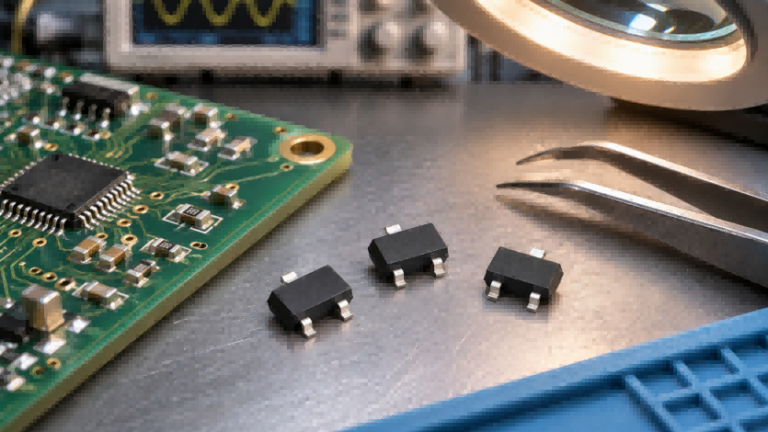
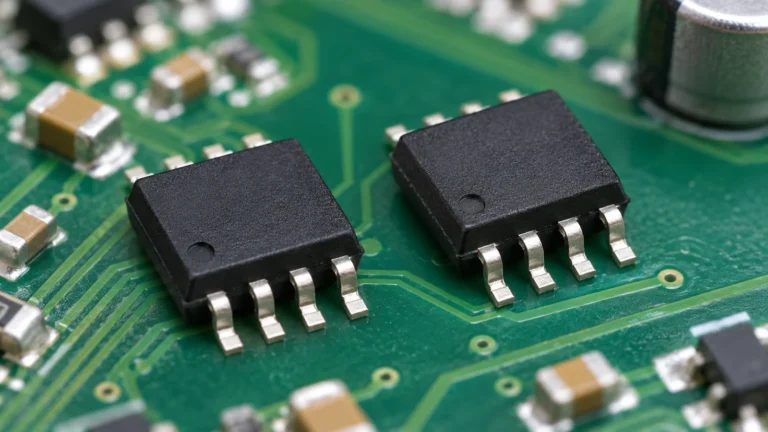
Physically, both TLV431BIDCKR and TLV431BCDCKR use the DCK 6-pin SC70 package. The family documentation lists the DCK package at a nominal 2 mm × 1.5 mm, and both orderable R versions use the same DCK package designation. This is a strong indication that they are intended for the same package footprint and pin configuration rather than representing two physically different versions.
That is an important distinction from comparisons where two similar electrical parts use different package codes. Here, the package itself is not the main differentiator; the temperature grade is. However, for an existing production PCB, physical similarity should still be confirmed against the exact ordering documentation rather than inferred only from a shortened or supplier-modified MPN.
The comparison up to this point establishes which specifications are actually different and which ones are shared. The next step is more practical: determining whether those differences allow one version to replace the other in an existing BOM, and whether that replacement works equally well in both directions.
Can TLV431BIDCKR-TP and TLV431BCDCKR-TP Replace Each Other?
Because the documented TLV431BIDCKR and TLV431BCDCKR devices share the same TLV431B architecture, DCK package, pin configuration, 1.24 V nominal reference, and basic cathode-current limits, they are much closer to each other than many similarly named component pairs. For an existing design, however, physical compatibility alone is not enough to declare a two-way replacement. The original temperature requirement still has to be preserved.
The most useful way to make the decision is therefore directional. A wider-temperature device used in a commercial-temperature design is not the same situation as a commercial-grade device being introduced into equipment originally qualified for industrial temperatures.
TLV431BIDCKR-TP Replacing TLV431BCDCKR-TP
If the original BOM specifies TLV431BCDCKR and the proposed alternative is TLV431BIDCKR, the replacement direction is generally the less restrictive of the two. Both documented base parts use the same DCK 6-pin SC70 package and TLV431B electrical architecture, while the I-grade device extends the rated operating temperature from the C-grade range of 0°C to +70°C to -40°C to +85°C.
For a board whose original design requirements remain within the commercial temperature range, the wider I-grade temperature capability does not inherently require a circuit redesign. The key checks are that the exact device supplied is the expected DCK version, the pin configuration matches the existing footprint, and the design does not depend on a qualification or procurement condition that is specific to the original part number.
In practical BOM work, this makes TLV431BIDCKR a potential replacement for TLV431BCDCKR when the electrical, package, and purchasing requirements are otherwise unchanged. For additional parts in the same BOM, an electronic parts cross reference can be useful for identifying possible alternatives before the same compatibility checks are applied.
TLV431BCDCKR-TP Replacing TLV431BIDCKR-TP
The reverse direction requires more caution. If TLV431BIDCKR was originally selected because the finished product must operate below 0°C or above +70°C, substituting the C-grade TLV431BCDCKR would reduce the specified operating-temperature coverage even though the package and nominal electrical characteristics are closely matched.
That means a commercial-grade device should not be treated as an equivalent simply because it fits the same PCB footprint. If the equipment is specified for factory automation, outdoor installations, cold storage, unconditioned enclosures, or another environment that can exceed the C-grade limits, the lower temperature rating becomes a direct qualification issue.
If the original design happens to use the I-grade part even though the actual required environment is entirely within 0°C to +70°C, a C-grade substitution may still be technically possible, but that conclusion should come from the product requirement and validation record rather than from the package code alone. A compatible footprint does not override an environmental requirement.
Which One Should You Choose?
For a new design, choosing between these two parts should be based primarily on the operating environment rather than on the idea that one version is universally “better.” Their shared TLV431B characteristics mean that the decision is less about basic regulator function and more about selecting the appropriate temperature grade for the product.
| Design Situation | Better Direction | Reason |
|---|---|---|
| Indoor commercial electronics | TLV431BCDCKR may be sufficient | Its 0°C to +70°C rating can cover controlled environments |
| Industrial or wider-temperature equipment | TLV431BIDCKR | Rated from -40°C to +85°C |
| Existing PCB replacement | Match the original grade first | Minimizes qualification changes |
| Supply-shortage substitution | Verify temperature requirement before approval | Same package does not guarantee the same environmental rating |
| New design with uncertain ambient conditions | Consider the wider-temperature grade | Provides more environmental margin |
The choice should therefore follow the actual product specification. Selecting the I-grade version only because it has a wider range can add specification margin, but it does not automatically improve the circuit’s electrical performance at room temperature. Conversely, choosing the C-grade version for availability or cost reasons is only appropriate when the finished product does not require the wider industrial range.
For engineers and sourcing teams, this distinction is important because component selection and component substitution are not identical tasks. A new design allows the grade to be chosen around known environmental requirements, while a replacement decision must also respect what the original BOM and finished product were already qualified to support.
BOM Replacement Checklist
A short validation process is usually more useful than comparing every line in two datasheets. For these two TLV431B variants, the following checks cover the parameters most likely to affect a real BOM substitution:
- Confirm the exact manufacturer part number. Do not rely only on a distributor SKU or shortened database description.
- Separate the base MPN from additional packaging or supplier suffixes. This is especially important when
-TPappears after the documented base part number. - Verify the package and pin configuration. Confirm that the proposed substitute is the same DCK package intended for the existing PCB.
- Check the reference-voltage grade and main electrical limits. Confirm that VREF, tolerance, cathode-voltage range, and cathode-current requirements remain suitable.
- Compare the required operating-temperature range. This is the most important difference between the C-grade and I-grade versions.
- Review any qualification requirements. Product approvals, customer specifications, or internal AVL rules may restrict substitutions even when the electrical specifications are similar.
- Validate the alternate part in the actual circuit before volume production. This is particularly important when the substitution will affect an established production BOM.
For broader sourcing projects, this checklist can be applied to other power management ICs as well. The principle remains the same: confirm the exact part, identify which specification differences are real, and then decide whether those differences matter to the actual design.
If a BOM-level replacement project also requires sourcing, samples, or engineering review, China Chip Depot can be used as the commercial entry point after the technical comparison is complete. Keeping that step after the engineering decision helps prevent availability from becoming the main reason for approving an unsuitable substitute.
Understanding the “-TP” Suffix
The -TP suffix should be treated separately from the confirmed differences between TLV431BIDCKR and TLV431BCDCKR. The documented orderable base part numbers use forms such as TLV431BIDCKR and TLV431BCDCKR, while the searched versions contain the additional -TP ending.
For sourcing purposes, that extra suffix should be verified against the specific quotation, BOM database, or supplier record where it appears. It may describe packaging or another ordering convention rather than a change to the underlying TLV431B silicon, but it should not be assigned a meaning unless that meaning is documented for the exact source.
This is also why comparison work should start from the manufacturer base MPN whenever possible. A difference introduced by a supplier database should not be confused with a difference in electrical grade, package, or temperature rating.
Final Comparison
TLV431BIDCKR and TLV431BCDCKR are closely related TLV431B devices with the same 1.24 V reference architecture, B-grade initial accuracy, and DCK 6-pin package. The main documented distinction is the operating-temperature grade: the I-grade version covers -40°C to +85°C, while the C-grade version covers 0°C to +70°C.
For an existing commercial-temperature design, the I-grade version can be considered a potential substitute when package, pinout, electrical limits, and procurement requirements are confirmed. The reverse substitution needs more caution because a C-grade device should not replace an I-grade device in equipment that depends on the wider industrial temperature range.
The practical rule is simple: match the electrical and physical requirements first, then make sure the replacement preserves the environmental requirement of the original design.
FAQs
What is the main difference between TLV431BIDCKR and TLV431BCDCKR?
The main difference is the rated operating-temperature range. TLV431BIDCKR is an I-grade device rated from -40°C to +85°C, while TLV431BCDCKR is a C-grade device rated from 0°C to +70°C. Their documented base devices otherwise share the same TLV431B family and DCK package.
Are TLV431BIDCKR and TLV431BCDCKR pin compatible?
Both documented base part numbers use the same DCK 6-pin SC70 package and corresponding package configuration. For production substitution, confirm the exact orderable part and package information rather than relying only on a supplier description.
Can TLV431BIDCKR replace TLV431BCDCKR?
It can be a suitable replacement when the exact DCK package, pin configuration, electrical requirements, and BOM conditions are confirmed. Its wider -40°C to +85°C temperature rating also covers the commercial temperature range of the C-grade version.
Can TLV431BCDCKR replace TLV431BIDCKR?
Only if the finished product does not require the wider I-grade temperature range. A shared package and similar electrical specifications do not make the C-grade version suitable for equipment that must operate below 0°C or above +70°C.
Does the “-TP” suffix change the electrical specifications?
The official family ordering information documents the base part numbers without -TP, so the suffix should be verified against the exact sourcing or BOM record where it appears. Do not assume that it represents a different electrical grade unless the source explicitly documents that meaning.