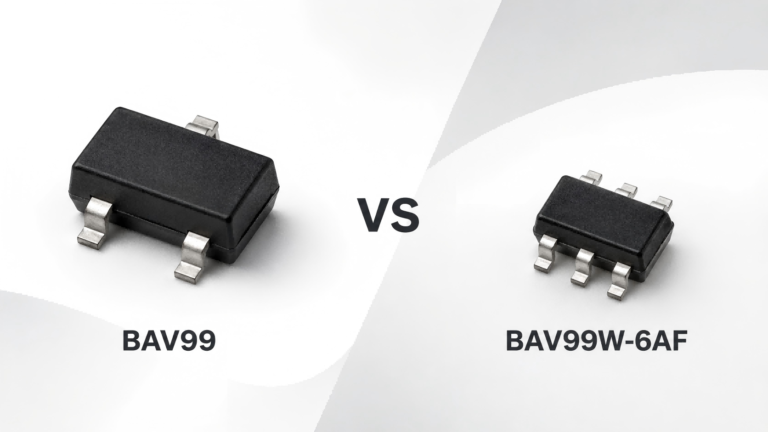
When engineers search for BAV99 vs BAV99W-6AF, they are usually not looking for a basic introduction to switching diodes. The real question behind this comparison is much more practical:
Are these two components interchangeable? Can BAV99W-6AF replace BAV99 in an existing design? What should be considered before changing the part number?
Although both devices belong to the BAV99 high-speed switching diode family, they are not always direct replacements. The main difference is not the diode function itself, but the package type, PCB footprint, and electrical limits related to the package size.
For engineers selecting components and procurement teams evaluating alternative sources, understanding these differences can help avoid unexpected PCB redesigns, assembly issues, or performance limitations.
What Are BAV99 and BAV99W-6AF?
BAV99 is a widely used high-speed switching diode array consisting of two diodes connected in series inside a single package. It is commonly used in signal switching, protection circuits, and general-purpose switching applications where fast response and low capacitance are required.
The BAV99W-6AF follows the same basic diode configuration but uses a smaller surface-mount package. It is typically supplied by manufacturers such as FOSAN and belongs to the same BAV99W family.
Both components provide similar electrical functions:
- Dual series diode configuration
- Fast reverse recovery characteristics
- Low capacitance
- Suitable for high-frequency switching applications
However, component selection cannot rely only on electrical similarity. In practical PCB design, the package and footprint are equally important.
A component with the same circuit function may still require PCB changes if the physical package is different.
BAV99 vs BAV99W-6AF Key Differences Comparison
The main differences between BAV99 and BAV99W-6AF are related to package size and current capability.
| Feature | BAV99 | BAV99W-6AF |
|---|---|---|
| Device Type | High-speed switching diode | High-speed switching diode |
| Diode Configuration | Dual series diode | Dual series diode |
| Package | SOT-23 | SOT-323 (SC-70) |
| Package Size | Approx. 2.9 × 1.3 mm | Approx. 2.0 × 1.25 mm |
| Reverse Voltage (VR) | Up to 100V (depending on manufacturer) | Typically 75V |
| Forward Current (IF) | Approx. 200mA range | 150mA |
| Power Dissipation | Higher due to larger package | Approx. 200mW |
| Reverse Recovery Time (trr) | Around 4ns | Around 4ns |
| Application | Switching, protection, signal processing | Compact switching applications |
From the comparison above, the two parts have similar switching characteristics, but BAV99 generally provides higher electrical margin because of its larger SOT-23 package.
The Main Difference: SOT-23 vs SOT-323 Package
For most replacement decisions, the package difference is the most important factor.
BAV99: SOT-23 Package
BAV99 is commonly available in the standard SOT-23 surface-mount package.
Advantages:
- Larger PCB footprint
- Better thermal performance
- Higher power handling capability
- Easier assembly and inspection
BAV99W-6AF: SOT-323 Package
BAV99W-6AF uses the smaller SOT-323 (SC-70) package.
Advantages:
- Requires less PCB space
- Suitable for compact electronic products
- Better for high-density PCB layouts
However, the smaller package also introduces limitations:
- Lower power dissipation
- Lower maximum current capability
- Different PCB footprint
Therefore, even though both parts perform the same diode function, they are not mechanically identical.
Can BAV99W-6AF Replace BAV99?
The short answer is:
BAV99W-6AF may replace BAV99 in some applications, but it is not a direct drop-in replacement.
The replacement decision depends on three factors.
1. Electrical Compatibility
From a circuit-function perspective, both components are:
- Dual series switching diodes
- High-speed switching devices
- Low-capacitance diode arrays
For applications with low current requirements and suitable voltage conditions, BAV99W-6AF can provide similar functionality.
However, engineers should verify:
- Reverse voltage requirement
- Continuous forward current
- Surge current conditions
- Power dissipation
A design originally using BAV99 at higher electrical limits may not have enough margin when replaced by BAV99W-6AF.
2. PCB Footprint Compatibility
This is the most common replacement problem.
BAV99:
- SOT-23 footprint
BAV99W-6AF:
- SOT-323 footprint
The pin arrangement and package dimensions are different.
This means:
- Existing PCB pads may not match
- Pick-and-place assembly programs may require changes
- PCB layout modification may be necessary
For a new PCB design, choosing either package is relatively simple.
For an existing production design, changing between them requires engineering verification.
3. Manufacturing and Supply Considerations
From a procurement perspective, choosing between BAV99 and BAV99W-6AF is not only a technical decision.
Manufacturers and purchasing teams should also evaluate:
- Supplier availability
- Production continuity
- Package availability
- Alternative sources
- Qualification requirements
A smaller package may reduce PCB size, but if the product already uses a qualified SOT-23 assembly process, changing to SOT-323 may introduce unnecessary validation costs.
When Should You Choose BAV99 or BAV99W-6AF?
The better choice depends on your design requirements.
| Application Situation | Recommended Choice |
|---|---|
| Existing PCB designed for SOT-23 | BAV99 |
| Need direct replacement without PCB change | BAV99 |
| New compact PCB design | BAV99W-6AF |
| Space-limited consumer electronics | BAV99W-6AF |
| Higher current or thermal margin required | BAV99 |
| High-volume sourcing flexibility | Evaluate supplier availability |
For engineers designing a new product, BAV99W-6AF can be attractive because of its smaller footprint.
For replacement projects, maintaining the original package is usually the safer option.
Understanding BAV99 Series Part Numbers
The BAV99 family includes multiple variants:
| Part Number | Meaning |
|---|---|
| BAV99 | Standard device version, commonly SOT-23 |
| BAV99W | Smaller SOT-323 package version |
| BAV99W-6AF | Manufacturer-specific ordering code based on BAV99W package |
The base device name indicates the diode family, while additional letters and numbers usually identify package versions, manufacturers, or ordering information.
Therefore, similar names do not always mean identical components.
When sourcing replacements, engineers should always confirm:
- Manufacturer datasheet
- Package type
- Pin configuration
- Electrical ratings
Manufacturer Perspective: How to Select the Right BAV99 Variant
From a component supplier and manufacturing perspective, the correct choice is not always the smallest or cheapest component.
A reliable selection process should consider:
For design engineers:
- Confirm electrical requirements first
- Select suitable package based on PCB constraints
- Verify thermal margin
- Check long-term component availability
For procurement teams:
- Avoid selecting replacements only by part number similarity
- Confirm manufacturer and package compatibility
- Verify production availability and lifecycle status
- Consider qualified alternative sources
A correct replacement is not simply a component with the same name. It must satisfy both electrical performance and manufacturing requirements.
Conclusion
BAV99 and BAV99W-6AF are closely related high-speed switching diodes, but they serve slightly different design needs. BAV99 focuses on broader electrical margin with a standard SOT-23 package, while BAV99W-6AF provides a compact SOT-323 solution for space-constrained designs.
For engineers, the key decision is not simply whether the two parts are electrically similar, but whether the replacement fits the complete system requirements: PCB design, electrical performance, manufacturing process, and supply reliability.
FAQs
BAV99W-6AF belongs to the same BAV99 switching diode family, but it is not exactly the same component. The main difference is the package type and related electrical ratings. BAV99 is commonly available in SOT-23, while BAV99W-6AF uses the smaller SOT-323 package.
No. Although they have similar diode functions, BAV99W-6AF is not a direct drop-in replacement because the PCB footprint is different. Engineers need to verify package compatibility before replacement.
Neither is universally better. BAV99 provides higher current capability and thermal margin, while BAV99W-6AF offers a smaller package suitable for compact PCB designs.
SOT-23 is a larger surface-mount package with better power handling capability. SOT-323 is a smaller package designed for space-saving applications but usually has lower power dissipation.
Before purchasing an alternative component, verify the datasheet, package type, pin configuration, voltage rating, current rating, and manufacturer qualification requirements.