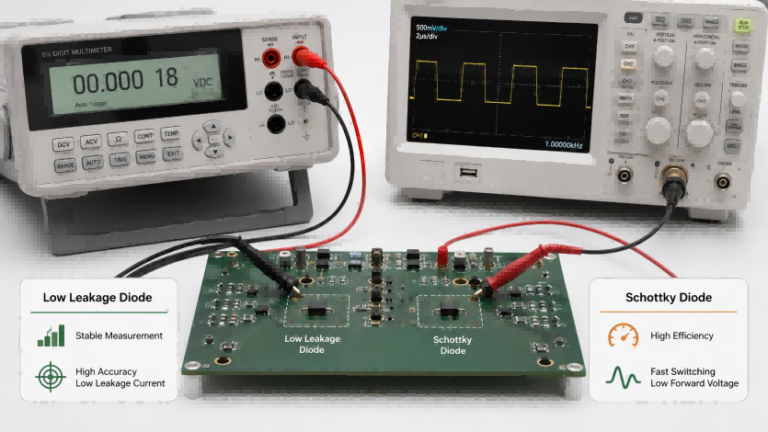
When selecting a diode for a circuit design, engineers often need to balance two competing requirements: low forward voltage drop and low reverse leakage current. Schottky diodes are widely used because of their low Vf and fast switching performance, but their higher leakage current can become a limitation in precision and low-power applications.
Low leakage diodes, on the other hand, are designed to minimize reverse current, making them suitable for high-impedance circuits, sensor interfaces, and measurement systems. Choosing between a low leakage diode and a Schottky diode depends on which parameter is more critical for the application: efficiency, switching speed, or signal accuracy.
This article explains the key differences between low leakage diodes and Schottky diodes, why their leakage characteristics differ, and how engineers can select the right diode for different circuit requirements.
Low Leakage Diode vs Schottky Diode: Key Differences
Although both low leakage diodes and Schottky diodes are used for controlling current flow in electronic circuits, they are optimized for different electrical characteristics.
A Schottky diode uses a metal-semiconductor junction instead of a traditional PN junction. This structure allows faster carrier movement, resulting in a lower forward voltage drop and faster switching speed. However, the same characteristics that improve efficiency also contribute to higher reverse leakage current.
A low leakage diode is usually based on a silicon PN junction optimized to reduce unwanted reverse current. It sacrifices some forward voltage performance and switching speed in exchange for better leakage characteristics.
The main differences can be summarized as follows:
| Feature | Low Leakage Diode | Schottky Diode |
|---|---|---|
| Junction Type | Silicon PN junction | Metal-semiconductor junction |
| Main Advantage | Extremely low reverse leakage current | Low forward voltage and fast switching |
| Forward Voltage (Vf) | Higher, typically around 0.6–0.7V for silicon PN types | Lower, typically around 0.2–0.45V |
| Reverse Leakage Current | Very low, from pA/nA range for specialized devices | Higher, commonly from μA to mA depending on device |
| Switching Speed | Moderate to fast depending on design | Very fast due to majority carrier operation |
| Temperature Stability | Better leakage performance | Leakage increases significantly with temperature |
| Typical Applications | Precision analog circuits, sensors, ADC protection | Power conversion, rectification, high-frequency switching |
The choice between these two diode types is not about which one is universally better. Instead, engineers need to determine whether the circuit is more sensitive to forward voltage loss or reverse leakage current.
For example:
- A DC-DC converter usually benefits from a Schottky diode because reducing forward voltage improves efficiency.
- A sensor input circuit usually requires a low leakage diode because even a small reverse current can create measurement errors.
Why Do Schottky Diodes Have Higher Reverse Leakage Current?
The difference in leakage performance comes from the internal structure of the diode.
A Schottky diode is formed by a metal-semiconductor junction. Compared with a silicon PN junction diode, it has a lower barrier height, which allows current to flow at a lower forward voltage.
This provides two important advantages:
- Lower forward voltage drop
- Faster switching response
Because Schottky diodes rely on majority carrier conduction and do not store minority carrier charge, they can switch much faster than conventional PN diodes.
However, the lower barrier also makes it easier for carriers to move when the diode is reverse biased. As a result, Schottky diodes generally have higher reverse leakage current.
In simple terms:
The same characteristics that make Schottky diodes efficient also cause higher leakage current.
This trade-off is why Schottky diodes are excellent for power applications but may not be ideal for precision circuits.
Factors Affecting Schottky Diode Leakage Current
The reverse leakage current of a Schottky diode is not a fixed value. It changes depending on several operating conditions.
Barrier Height
A lower barrier height reduces forward voltage but usually increases leakage current. High-efficiency Schottky diodes often accept higher leakage as a trade-off for lower conduction losses.
Reverse Voltage
Leakage current increases as reverse voltage rises. Engineers should always check the datasheet reverse leakage specification under the actual operating voltage rather than relying only on the maximum rating.
Temperature
Temperature has a significant impact on Schottky diode leakage.
A diode with a low leakage specification at room temperature may show much higher leakage at elevated temperatures. This is especially important in:
- Automotive electronics
- Outdoor equipment
- Battery-powered systems
For designs requiring stable leakage performance, engineers should evaluate the reverse current specification across the expected temperature range.
Silicon Diode vs Schottky Diode Leakage: Which One Has Lower Leakage?
When comparing silicon PN diodes and Schottky diodes, silicon PN diodes generally provide lower reverse leakage current.
This is why many low leakage diode designs use optimized silicon PN junction structures rather than standard Schottky technology.
The typical leakage comparison is:
| Diode Type | Typical Reverse Leakage Current |
|---|---|
| Ultra low leakage silicon diode | pA to nA range |
| Low leakage silicon PN diode | nA range |
| Standard silicon switching diode | nA to μA range |
| Standard Schottky diode | μA to mA range |
However, leakage current depends on more than diode type alone. The actual value is affected by:
- Reverse voltage rating
- Junction size
- Manufacturing process
- Temperature
- Measurement conditions
For example, a high-quality Schottky diode may achieve lower leakage than a poorly optimized silicon diode. Therefore, engineers should always compare actual datasheet specifications rather than relying only on diode categories.
In general:
- If the priority is the lowest possible reverse leakage current, a low leakage silicon PN diode is usually the better choice. For applications requiring extremely low reverse current levels, engineers may need to evaluate ultra low leakage diodes designed specifically for precision measurement and high impedance circuits.
- If the priority is low forward voltage and fast switching, a Schottky diode is usually preferred.
When Does Reverse Leakage Current Matter in a Circuit?
Reverse leakage current is often ignored in power applications because the leakage loss may be very small compared with the load current.
However, leakage becomes critical when the diode is connected to a high-impedance node.
The impact of leakage depends not only on the diode specification but also on the circuit impedance.
The relationship can be simplified as:
Voltage Error = Leakage Current × Circuit Resistance
For example:
A 1 μA leakage current may have little impact on a 10 kΩ node:
- Voltage error = 10 mV
But the same leakage current on a 1 MΩ node creates:
- Voltage error = 1 V
This can completely affect signal accuracy.
High-impedance circuits that are sensitive to diode leakage include:
| Application | Why Leakage Matters |
|---|---|
| Sensor circuits | Small leakage can distort weak measurement signals |
| ADC input protection | Leakage can introduce measurement offset |
| Sample-and-hold circuits | Leakage causes stored voltage decay |
| Precision amplifiers | Leakage affects input accuracy |
| Battery-powered standby circuits | Leakage increases idle power consumption |
This is why a Schottky diode that works perfectly in a power supply may create problems in a precision analog circuit.
For example, engineers on electronics forums often point out that a Schottky diode connected to a high-impedance node can create unexpected voltage offsets because of its reverse leakage current. In these cases, selecting a low leakage diode is often more important than achieving the lowest forward voltage.
Low Leakage Diode vs Schottky Diode: Application-Based Selection
After understanding the electrical differences between low leakage diodes and Schottky diodes, the next question engineers usually face is:
Which diode should be selected for a specific application?
The answer depends on the main design priority:
- Choose a Schottky diode when low forward voltage and fast switching are the most important factors.
- Choose a low leakage diode when reverse current must be minimized to protect signal accuracy, standby power, or measurement stability.
The following table summarizes common selection scenarios.
| Application | Recommended Choice | Main Reason |
|---|---|---|
| DC-DC converters | Schottky diode | Low forward voltage reduces conduction loss and improves efficiency |
| Power rectification | Schottky diode | High current capability and low voltage drop |
| High-frequency switching circuits | Schottky diode | Faster switching performance due to majority carrier operation |
| Sensor input protection | Low leakage diode | Minimizes signal error caused by reverse current |
| ADC input protection | Low leakage diode | Prevents measurement offset and accuracy loss |
| Sample-and-hold circuits | Low leakage diode | Reduces charge loss during holding periods |
| Precision analog circuits | Low leakage diode | Maintains signal integrity in high-impedance nodes |
| Battery-powered standby systems | Low leakage diode or optimized Schottky | Reduces unwanted current consumption |
For small signal switching applications, engineers may also need to compare different BAV99 switching diode options based on package size, electrical characteristics, and replacement compatibility.
Power Efficiency vs Signal Accuracy
The selection often comes down to a trade-off between efficiency and accuracy.
For power electronics, the forward voltage drop is usually the dominant concern.
For example, in a battery charger or switching converter:
- Lower Vf means lower power loss.
- Faster switching reduces switching losses.
- Higher leakage current may be acceptable because the load current is much larger.
This is where Schottky diodes are commonly used.
However, in precision circuits:
- The operating current may be extremely small.
- The signal voltage may only be a few millivolts.
- Even nanoamp-level leakage can affect circuit performance.
In these situations, a low leakage diode is usually the better choice.
Can You Replace a Schottky Diode with a Low Leakage Diode?
A common question during circuit redesign or component sourcing is whether a Schottky diode can be replaced with a low leakage diode.
The short answer is:
Not always.
Although both devices perform the same basic function of allowing current flow in one direction, their electrical characteristics are different.
Before replacing a Schottky diode with a low leakage diode, engineers should check several parameters.
Forward Voltage Requirement
Schottky diodes are often selected because they provide a very low forward voltage drop.
For example:
- Schottky diode: around 0.3V
- Silicon PN diode: around 0.6–0.7V
If the circuit depends on the lower voltage drop, replacing it with a PN diode may reduce performance.
Typical examples include:
- Low-voltage power supplies
- Battery-powered circuits
- Voltage clamping applications
Switching Speed
Schottky diodes are widely used in high-frequency applications because they have very fast switching characteristics.
A low leakage PN diode may have:
- Higher reverse recovery time
- Higher switching losses
Therefore, replacement should consider the operating frequency.
Reverse Leakage Requirement
In precision circuits, the opposite situation may happen.
Replacing a Schottky diode with a low leakage diode can improve:
- Measurement accuracy
- Signal stability
- Standby power consumption
This is common in:
- Sensor interfaces
- Analog measurement systems
- ADC protection circuits
Current and Voltage Ratings
Any replacement diode must also meet:
- Reverse voltage rating
- Forward current rating
- Power dissipation capability
- Package requirements
A diode with lower leakage is not automatically a suitable replacement if its electrical ratings are insufficient.
How to Select the Right Diode for Your Design
Selecting between a low leakage diode and a Schottky diode should start with identifying the most important circuit requirement.
Step 1: Determine the Main Design Priority
Ask what the circuit needs most:
| Design Priority | Recommended Diode Type |
|---|---|
| Lowest power loss | Schottky diode |
| Fast switching | Schottky diode |
| Lowest reverse leakage | Low leakage diode |
| Highest measurement accuracy | Low leakage diode |
| Lowest standby current | Low leakage diode or optimized Schottky |
Step 2: Compare Datasheet Parameters
Engineers should compare the following specifications:
| Parameter | Why It Matters |
|---|---|
| Reverse leakage current (Ir) | Determines unwanted current flow during reverse bias |
| Forward voltage (Vf) | Affects conduction loss and efficiency |
| Reverse voltage rating | Ensures safe operation under maximum voltage |
| Junction capacitance | Important for high-speed switching applications |
| Temperature characteristics | Determines leakage behavior in real environments |
Do not compare only one parameter.
A diode with the lowest forward voltage may not be the best choice if leakage current creates unacceptable circuit errors.
Step 3: Consider Operating Temperature
Temperature is one of the most important factors when evaluating diode leakage.
A diode that performs well at room temperature may behave differently in:
- Industrial equipment
- Automotive systems
- Outdoor electronics
For applications with wide temperature ranges, engineers should check reverse leakage specifications at the actual operating temperature instead of relying only on 25°C datasheet values.
Low Leakage Diode vs Schottky Diode: Final Selection Summary
Low leakage diodes and Schottky diodes are designed for different engineering priorities.
A Schottky diode is usually the better choice when the circuit requires:
- Low forward voltage
- Fast switching
- High efficiency
- Power conversion performance
A low leakage diode is usually preferred when the circuit requires:
- Minimal reverse current
- Stable measurements
- High impedance protection
- Low standby power consumption
The best choice depends on the application rather than the diode type alone.
For engineers selecting semiconductor components for production designs, factors such as electrical specifications, package availability, and long-term supply stability should also be considered. A semiconductor supplier such as China Chip Depot can support component sourcing and replacement evaluation for different electronic design requirements.
FAQs
No. Standard Schottky diodes usually have higher reverse leakage current than silicon PN diodes.
Silicon PN diodes generally have lower reverse leakage current than Schottky diodes.
Schottky diodes provide lower forward voltage and faster switching speed.
Use a low leakage diode when reverse current may affect signal accuracy, standby power, or high-impedance circuits.